
Did you know that 95% of organizations tracking the ROI of their health initiatives report a positive return on that investment? When you’re proposing a wellness program to management, it’s natural to feel a sense of hesitation, especially if you’re worried about quantifying mental clarity and internal balance within a corporate spreadsheet. You likely recognize that your team’s vitality is the true heartbeat of the company, yet the fear of rejection based on costs often keeps these transformative ideas from taking flight.
It’s a common challenge to bridge the gap between the quiet promise of holistic well-being and the firm, data-driven expectations of a boardroom. We’re here to help you navigate this process with confidence and serenity. In this guide, you’ll learn how to build a persuasive, data-backed case that speaks the language of leadership while honoring the health of your staff. We’ll provide a clear proposal structure that covers everything from 2026 tax offsets to productivity gains, ensuring your path from theory to practice is steady, logical, and ultimately successful in securing executive buy-in.
Key Takeaways
- Understand the shift toward long-term organizational sustainability and why holistic health is now a core priority for leadership in 2026.
- Master the art of proposing a wellness program to management by using data-driven metrics to demonstrate a clear return on investment through improved productivity and lower healthcare costs.
- Implement a professional 5-step framework to assess employee needs and establish measurable goals that secure long-term leadership buy-in.
- Learn how to address common objections regarding time and space by integrating flexible, on-site Corporate Yoga sessions that fit seamlessly into the work day.
- Discover how customized programs, from ladies-only sessions to specialized yoga for seniors, can address the diverse physical needs of your entire workforce.
Understanding the Shift: Why Management Cares About Wellness in 2026
True health is the foundation of every successful enterprise; it’s the quiet energy that fuels innovation and endurance. In previous years, office yoga or gym memberships were often viewed as mere perks or “nice-to-haves.” Today, these initiatives have evolved into essential components of corporate sustainability. As the global corporate wellness market is projected to reach $100 billion by the end of 2026, the shift in perspective is undeniable. Leadership teams now recognize that a business is only as resilient as its people.
Across the UAE, we see a rising tide of interest in holistic health that transcends traditional fitness. Decision-makers are realizing that a fragmented approach to well-being simply doesn’t work in a high-pressure environment. When you’re proposing a wellness program to management, it’s vital to emphasize the link between mental clarity and high-stakes decision-making. A clear, grounded mind leads to precise, effective actions. Conversely, adopting a “wait and see” approach to employee burnout is a financial risk that can lead to talent loss and decreased operational efficiency.
The Cost of Inaction: Absenteeism vs. Presenteeism
While absenteeism is easy to track on a spreadsheet, presenteeism is a silent thief of organizational energy. Presenteeism happens when employees are physically at their desks but mentally disengaged due to stress, fatigue, or physical discomfort. Research shows that Workplace wellness programs are critical in combatting this drain. Unaddressed chronic stress often leads to long-term medical leave, which carries significant costs for the employer. The sedentary nature of office life also takes a heavy toll on spinal health. Without regular movement, productivity withers. Investing in the physical alignment of your team isn’t just a kind gesture; it’s a strategic necessity.
Aligning Wellness with ESG and Corporate Responsibility
Modern investors and prospective hires look for organizations that value more than just the bottom line. Wellness initiatives now play a critical role in the Social (S) pillar of Environmental, Social, and Governance (ESG) reporting. By fostering a genuine culture of care, you build a brand that naturally attracts and retains top-tier talent. This transformation starts at the top. When leadership sets the tone for a healthy work-life balance, it gives the entire team permission to prioritize their own vitality. Proposing a wellness program to management is your opportunity to align your company’s daily operations with its highest values of integrity and human respect.
The Financial Case: Calculating the ROI of a Wellness Program
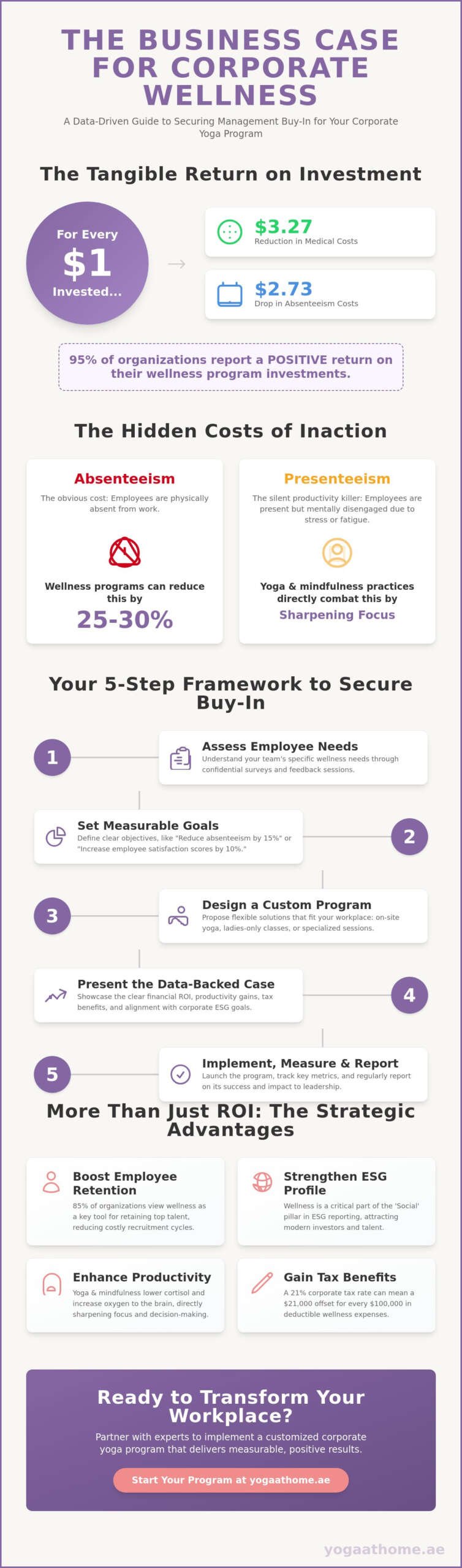
A healthy balance sheet begins with a healthy workforce. While the emotional benefits of a calm office are evident, proposing a wellness program to management requires a shift toward hard financial metrics. Research indicates that for every $1 invested in a comprehensive initiative, companies can see up to $6 in healthcare savings. This isn’t just a projection; it’s a measurable reality where medical costs fall by about $3.27 and absenteeism costs drop by $2.73 for every dollar spent. By following seven best practices for a wellness program, you can transform these statistics into a bespoke strategy for your organization.
When you’re proposing a wellness program to management, it’s vital to emphasize the 25-30% reduction in absenteeism that comprehensive programs typically deliver. Internal surveys often reveal that high turnover and low engagement are the true “pain points” affecting the bottom line. Consider the fiscal impact of even a 5% increase in employee retention. Since 85% of organizations view wellness as a key retention tool, the investment becomes a safeguard against the high cost of recruitment. There’s also a significant federal tax benefit to consider; the 21% corporate tax rate allows for a $21,000 offset for every $100,000 in deductible wellness expenses. To ensure your organization is positioned to take full advantage of these fiscal benefits and regulatory structures, Set Hub provides expert guidance on business setup and company formation throughout the UAE.
Productivity Gains from Mindfulness and Movement
Yoga and rhythmic breathing aren’t just for the mat; they are tools for cognitive precision. These practices lower cortisol and increase oxygen flow to the brain, which directly sharpens focus and decision-making capabilities. We often see the “afternoon slump” drain the energy of a team, leading to errors and delays. A structured 20-minute yoga session resets cognitive load for the afternoon, allowing employees to return to their tasks with renewed mental clarity and steady energy.
Mitigating the “Back Pain Crisis” in the Office
Sedentary work environments create a hidden crisis of chronic spinal discomfort. This leads to increased physical therapy claims and reduced daily output as staff struggle with persistent pain. Targeted yoga for back pain serves as a form of preventative physiotherapy, addressing the root cause of ergonomic strain before it requires medical intervention. Investing in spinal health reduces the frequency of chiropractic visits and long-term leave. If you’re ready to bring this restorative balance to your office, exploring a Corporate Yoga program is a logical next step.
A 5-Step Framework for Your Wellness Program Proposal
A well-structured proposal is more than a document; it’s a vision of a vibrant, resilient future for your organization. When you’re proposing a wellness program to management, you must provide a clear map that leads from current stressors to future vitality. By following a logical progression, you demonstrate that your initiative is a grounded business strategy rather than a fleeting trend. This framework ensures every detail is considered, from the quietest breath to the final balance sheet.
- Step 1: Needs Assessment. Begin by conducting anonymous employee health audits to identify specific pain points. Understanding whether your team struggles with mental fatigue or physical tension allows you to build a bespoke solution.
- Step 2: Defining Clear Objectives. Set SMART goals that align with executive priorities. Aim for specific targets, such as a 25% reduction in absenteeism or a measurable increase in employee engagement scores within the first year.
- Step 3: Program Design. Select modalities that serve your unique workforce. You might choose Hatha Yoga for its foundational balance or Ladies Yoga to provide a supportive, tailored environment for female staff members.
- Step 4: Logistics and Budgeting. Detail the “where” and “how.” Focus on the convenience of on-site delivery, which eliminates travel time and integrates seamlessly into the professional day.
- Step 5: Measurement and Reporting. Establish a system for tracking success. Regular reports on participation rates and healthcare savings will prove the program’s value to the board over time.
Crafting an Executive Summary that Commands Attention
The opening of your proposal should lead with the “Why” before the “What.” Instead of starting with the logistics of a yoga mat, start with the promise of a focused, high-performing leadership team. Use professional, rhythmic language to convey both authority and serenity. A single, high-impact paragraph should summarize how proposing a wellness program to management will directly solve retention issues and foster a culture of sustainable excellence. This sets a tone of quiet confidence that resonates with decision-makers.
Budgeting for Wellness: Fixed Costs vs. Variable Benefits
Management appreciates clarity in financial planning. Structure your proposal with “Good, Better, Best” options to show flexibility and respect for the company’s fiscal cycle. Fixed costs, such as recurring service contracts for on-site private instruction, are often more efficient than external gym memberships. On-site sessions minimize downtime and ensure that the practice remains accessible to everyone. By comparing these fixed investments against the variable benefits of reduced turnover and lower insurance claims, you present a compelling case for long-term health.
Overcoming Common Management Objections
A visionary leader often sees the value of health but may hesitate at the perceived logistical hurdles. When you’re proposing a wellness program to management, you’ll likely encounter practical questions regarding physical space, time constraints, and legal safety. These concerns are natural. They reflect a respect for the company’s current operations and a desire for any new initiative to be seamless and risk-free. Addressing these objections with grounded, professional solutions allows the conversation to move from “how” to “when.”
Time is a precious resource in any high-performance environment. Management might worry that a 60-minute session is too long for a busy team to step away from their desks. We solve this through flexible scheduling and “micro-wellness” sessions. A 15 or 30-minute focused breathing and stretching session can be just as effective at restoring cognitive function as a full-length class. Participation is also easily tracked through unified digital platforms, giving leadership the data they need to see exactly how the team is engaging with the program. This transparency builds trust and confirms the program’s value.
The “No-Space” Solution: Mobile and Desk-Based Wellness
One of the most frequent hurdles is the belief that an on-site studio is a prerequisite for success. This isn’t the case. Modern corporate wellness is built on the principle of adaptability. By transforming a standard boardroom into a temporary sanctuary or even encouraging desk-based movement, you remove the need for dedicated infrastructure. Mobile instructors bring all necessary equipment to your location, ensuring that the transition from work to wellness is effortless. This zero-infrastructure approach is a significant cost-saver that makes the program immediately viable for offices of any size.
Ensuring Professional Standards and Safety
Safety and reliability are the cornerstones of a sustainable program. Management needs to know that the team is in expert hands. We ensure that all corporate trainers hold industry-standard certifications, such as REPS UAE and Yoga Alliance. These credentials provide the necessary assurance regarding insurance and liability, protecting both the employee and the organization. Our yoga classes in Dubai set a national standard for private professional instruction, offering a level of expertise that larger, anonymous entities cannot match. If you’re ready to address these concerns with a customized plan, explore our Corporate Yoga solutions to see how we can fit into your unique environment.
Partnering with Experts: Implementing Your Program with Yogaathome
Health is the silent partner of every great achievement; it provides the steady foundation upon which all professional success is built. When you’re proposing a wellness program to management, the final bridge between a visionary idea and a lived reality is the choice of a reliable partner. Yogaathome is the logical choice for organizations that value both ancient wisdom and modern professional reliability. We don’t just offer classes; we provide a restorative process that integrates seamlessly into the busy lives of your team, ensuring that wellness becomes an accessible way of life rather than a distant goal.
Our commitment to holistic transformation is matched by our dedication to convenience. We bring the practice to you, offering location-specific instruction that respects your team’s schedule and environment. Whether it’s a boardroom in Dubai or an office in Abu Dhabi, our doorstep and office delivery across the UAE removes every barrier to entry. By choosing a partner that prioritizes bespoke service, you ensure that your Corporate Yoga initiative feels like a natural extension of your company culture, fostering a sense of tranquility and warmth that mirrors the core of our practice.
Specialised Instruction for Diverse Workforces
A truly effective program recognizes the unique physical and cultural needs of every individual. We pride ourselves on our inclusive approach, offering Ladies Yoga sessions led by expert female trainers to ensure cultural comfort and a supportive environment for female staff. For your senior leadership team, we provide Yoga for Seniors, focusing on gentle mobility and spinal health to ensure long-term vitality at the top. This level of customization extends to every stage of life, including Pre-natal Yoga for expectant employees, demonstrating a deep degree of empathy and care for your entire workforce’s personal growth.
Next Steps: Launching Your Pilot Program
The path from a proposal to a thriving workplace culture begins with a single, intentional step. We recommend starting small to gauge interest and build momentum. You might begin with a “Wellness Week” or a specialized workshop to introduce the benefits of regular practice to your team. To begin this journey, you can book an initial consultation for a corporate workshop where our expert staff members will help you design a recurring service contract tailored to your specific needs. Contact Yogaathome today to create a bespoke program that aligns with your company’s values and secures a healthier, more productive future for everyone.
Cultivating a Resilient Future for Your Organization
True success isn’t just measured by the bottom line; it’s seen in the vitality and focus of the people who build it every day. We’ve explored how shifting from simple office perks to a strategic health foundation can transform your corporate culture. By using data-driven metrics and a clear 5-step framework, you’ve learned that mental clarity and physical alignment are powerful tools for organizational longevity. When you’re proposing a wellness program to management, you’re not just asking for a budget; you’re offering a roadmap to a more engaged and resilient workforce.
The journey toward a healthier office is a collaborative process. Our team of REPS UAE Certified Instructors and Yoga Alliance Professionals is ready to support you with specialized expertise in Ladies Yoga and Yoga for Seniors. We provide the professional reliability and bespoke care needed to turn your vision into a reality. Take the next step in your leadership journey and Request a Bespoke Corporate Wellness Proposal from Yogaathome today. We look forward to helping you create a workplace where every employee can thrive with peace and purpose.
Frequently Asked Questions
How do I start a wellness program with no budget?
You can initiate a culture of health by implementing “walking meetings” or daily five-minute stretching breaks that require zero financial investment. Focus on building the habit first by sharing educational resources on spinal health and mental clarity. Once you’ve demonstrated employee interest through high participation, you’ll have a stronger case when proposing a wellness program to management that requires a formal budget.
What are the most effective wellness activities for office workers?
Activities that address the physical toll of sedentary work, such as Yoga for back pain and mindful breathing exercises, are exceptionally effective. These practices specifically target common office ailments like spinal compression and mental fatigue. Integrating short, focused movement sessions helps reset cognitive load and improves circulation, providing a sustainable energy boost that lasts much longer than a caffeine break.
How can we measure the success of a corporate yoga program?
Success is measured through a blend of hard financial data and qualitative employee feedback. Track metrics like reduced absenteeism and changes in healthcare premium costs alongside anonymous surveys regarding stress levels and job satisfaction. According to 2026 industry reports, 95% of companies that measure these outcomes report a positive return, making it easier to justify the program’s continuation to the board.
Is yoga suitable for all fitness levels in a corporate setting?
Yes, professional instruction is designed to be inclusive and non-intimidating for everyone, regardless of their current physical condition. A skilled mentor provides modifications for every pose, ensuring that beginners and advanced practitioners alike feel supported. This approach lowers the barrier to entry and ensures that wellness is a way of life accessible to all demographic groups within your workforce.
How often should corporate wellness sessions be held to see results?
Consistency is the foundational pillar of any restorative process; aim for at least one to two sessions per week. Regularity allows the body and mind to build a rhythmic memory of relaxation and strength. While even a single workshop provides immediate relief, a recurring schedule is necessary to see long-term improvements in employee morale, productivity, and overall spinal health.
Do we need special equipment for office yoga sessions?
You don’t need a dedicated studio or expensive equipment to begin a successful program. Many sessions can be conducted using standard office chairs or in existing boardrooms with portable mats provided by the instructor. This “zero-infrastructure” model makes proposing a wellness program to management much simpler, as it removes the need for permanent renovations or storage space.
Can wellness programs be conducted for remote or hybrid employees?
Modern wellness initiatives are highly adaptable and can be delivered through virtual platforms to support a hybrid workforce. Live, interactive sessions ensure that remote employees feel just as included and valued as those in the office. This flexibility is crucial in 2026, as it maintains a unified culture of care regardless of where your team members are physically located.
What certifications should a corporate yoga instructor have?
Professional reliability is confirmed by industry-standard certifications such as REPS UAE and Yoga Alliance, often complemented by specialized health coach training UK from Active Health Group. These credentials ensure that the instructor has the deep expertise required to manage diverse physical needs safely and effectively. Partnering with certified specialists protects your organization from liability while guaranteeing a high standard of instruction that respects the client’s time and growth.