What if the true measure of your yoga practice isn’t how close your forehead gets to your knees, but how quiet your nervous system becomes during the stretch? It’s natural to feel stuck when your physical reach doesn’t seem to change from week to week. You might even find yourself frustrated by slow results or confused by the fine line between a productive stretch and an impending injury. We believe that health is an intrinsic value, and your journey toward wellness should be a restorative process rather than a source of stress. This comprehensive guide focuses on measuring progress in flexibility with yoga by using professional benchmarks and mindful self-assessment.
You’ll discover how to accurately track your transition from stiffness to serenity while gaining a deeper understanding of the physiological changes occurring within your body. By shifting your focus from outward performance to internal balance, you can build the confidence needed to sustain a lifelong practice. We will explore a clear roadmap for tracking improvement, explain the science of muscle lengthening, and provide the tools you need to ensure your journey remains both safe and deeply transformative. This approach ensures your practice is accessible and non-intimidating, allowing you to flourish at your own pace.
Key Takeaways
- Learn how flexibility is a rhythmic dialogue between your muscles and your nervous system, moving beyond the deceptive metrics of mirrors and scales.
- Discover a dual-tracking framework that combines hard data with internal awareness to stay motivated during phases of invisible progress.
- Master the art of measuring progress in flexibility with yoga by establishing a consistent testing environment for accurate cold and warm assessments.
- Understand how a certified mentor can identify alignment blind spots and provide professional adjustments to accelerate your milestones safely.
- Gain the tools to distinguish between productive stretching and potential injury, ensuring your restorative journey remains sustainable and life-long.
Beyond the Fingertips: Redefining Flexibility Progress in Yoga
Flexibility isn’t a destination; it’s a dynamic state of being. We define true progress as the harmonious synergy between joint range of motion and muscle elasticity. When measuring progress in flexibility with yoga, many practitioners mistakenly rely on the bathroom scale or the hallway mirror. These are deceptive metrics that often obscure real growth. A scale cannot measure the newfound space between your vertebrae, and a mirror won’t reveal the increased hydration of your fascia. We invite you to look deeper into the subtle shifts that signal a body in transformation.
Our focus remains on “Functional Flexibility.” This concept moves beyond the ability to perform a specific pose for an aesthetic result. It’s about ensuring your body can move through daily life with grace and longevity. Understanding The Science of Suppleness helps us realize that progress is primarily an internal physiological shift. It’s a process where the nervous system learns to trust the body’s new ranges. We encourage a practice of non-attachment to the final asana. When you let go of the need to “touch your toes,” you create the mental space necessary for the body to actually open.
The Four Pillars of Progress
- Depth: This is the physical distance reached in a specific pose. While it’s the most visible marker, it’s only one piece of a much larger puzzle.
- Ease: You’ll notice a significant reduction in perceived effort. The muscular “fight” or resistance you once felt during a stretch begins to dissolve into a sense of fluid release.
- Breath: The ability to maintain a steady, calm ujjayi or diaphragmatic rhythm is a profound sign of progress. If your breath is jagged, your body isn’t yet comfortable in that range.
- Duration: This measures how long you can hold a pose with integrity and mental stillness. True flexibility includes the strength to remain present in the stretch.
Why Subjective Feeling Matters
Your body is a changing landscape, not a static object. It’s perfectly normal to experience a “morning stiffness” baseline that differs greatly from your evening peak flexibility. Measuring progress in flexibility with yoga requires acknowledging these natural, rhythmic cycles. You’ll eventually learn to identify the “sweet spot” where effort meets surrender. This is the threshold where growth happens without the risk of injury. Over time, you’ll notice a beautiful psychological shift. The internal dialogue moves from a frustrated “I can’t” to a gentle, grounded “I am curious.” This shift in perspective is the hallmark of a mature and restorative yoga journey.
The Science of Suppleness: What Happens Inside Your Body?
True flexibility begins where your biological safety mechanisms meet your conscious intent. Within your muscles and tendons lies a sophisticated sensor called the Golgi Tendon Organ (GTO). This organ acts as a biological circuit breaker, sensing tension and sending signals to the brain to prevent muscle tears. When you first enter a deep stretch, the GTO often triggers a protective contraction. Yoga is the art of “re-training” this nervous system response. Through patient, consistent practice, you teach your brain that these new ranges of motion are safe, eventually allowing the GTO to relax its grip.
When measuring progress in flexibility with yoga, you’re essentially tracking the evolution of your nervous system’s tolerance. It’s a delicate negotiation between your mind and your body’s survival instincts. This process is deeply influenced by your internal environment. For instance, connective tissues require proper hydration and specific nutrients like vitamin C and amino acids to maintain their resilience. Without adequate water, your fascia, the silvery web of tissue surrounding your muscles, becomes brittle and prone to “sticking,” which creates the sensation of being permanently tight.
The Parasympathetic Connection
You cannot effectively lengthen your body while trapped in a “fight or flight” state. High cortisol levels, the primary markers of stress, cause muscle fibers to remain in a state of vigilant contraction. Restorative breathing is the bridge that carries you into the parasympathetic nervous system. Deep, rhythmic exhalations signal the brain that the environment is secure, allowing for a profound muscular release that sheer force could never achieve. If you’re struggling with chronic tension, exploring Yoga for back pain can provide a structured way to signal this safety to your lower spine and hips.
Understanding Fascia: The Body’s Web
Fascia is the continuous, three-dimensional web of connective tissue that holds our physical shape. Unlike muscles, which can stretch and contract quickly, fascia requires sustained, gentle pressure to remodel itself. This is why long-term, consistent practice is vital. Over months of dedicated movement, you begin to break down fascial adhesions, those “knots” where layers of tissue have bonded together due to inactivity or stress. This remodeling is a slow, beautiful transformation of your very structure. As you navigate this internal change, utilizing a Quantitative vs. Qualitative: A Dual-Tracking Framework can help you appreciate the subtle shifts in your fascial health that a mirror might miss. This scientific perspective ensures your journey is grounded in professional reliability, moving you steadily from stiffness to a state of serene, fluid motion.
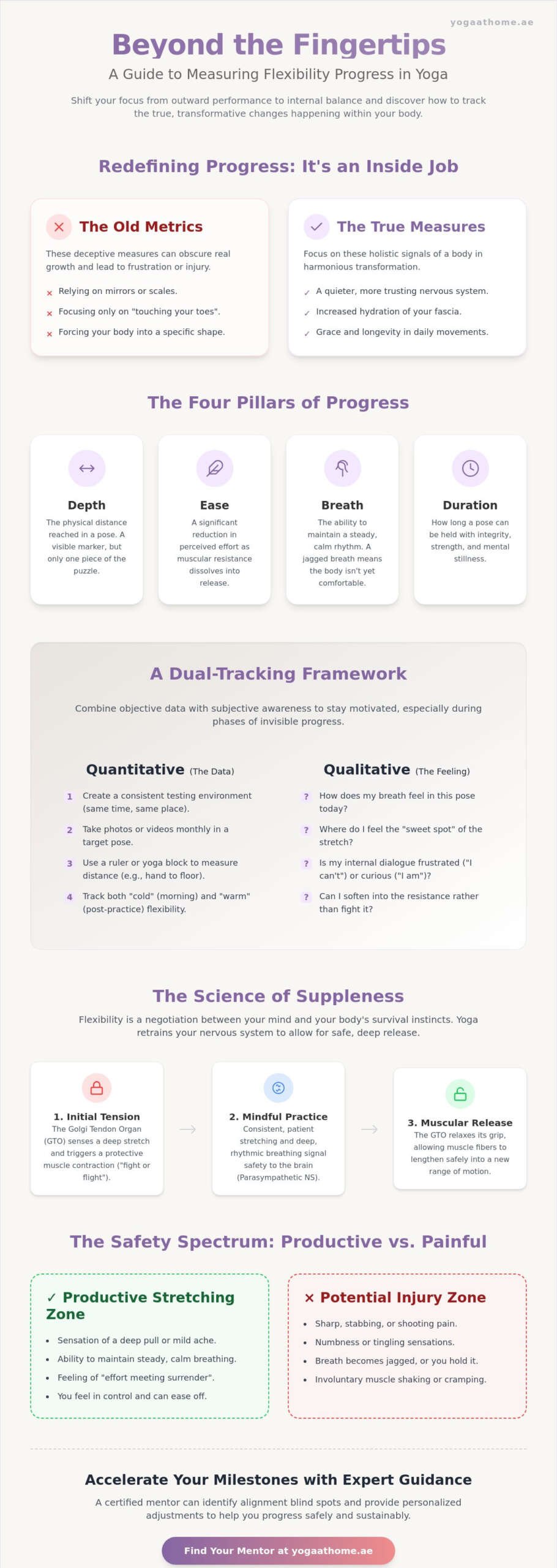
Quantitative vs. Qualitative: A Dual-Tracking Framework
Progress in a restorative journey is rarely a straight line. There are seasons of rapid opening and quiet weeks where the body feels static. Measuring progress in flexibility with yoga requires a dual lens to capture both the visible shifts and the subtle internal transformations. While we honor the ancient wisdom of simply “being,” modern professional reliability suggests that tracking tangible data can provide the motivation needed during phases of invisible progress. By combining hard metrics with soft sensations, you create a comprehensive map of your growth that respects both your physical effort and your mental clarity.
We recommend maintaining a “Proprioceptive Journal.” This isn’t just a diary of poses; it’s a dedicated tool for recording your “inner weather.” Alongside this, the “Yoga Progress Photo” protocol offers objective visual evidence. To do this effectively, take photos every four weeks in the same lighting, at the same time of day, and from the same angle. This consistency ensures that the changes you see are real, not just a result of different shadows or camera heights. These tools help you move beyond frustration, allowing you to see the serene reality of your transformation.
Hard Metrics: The Numbers
Data provides a grounded foundation for your practice. It helps you see that you are, in fact, moving forward even when you don’t “feel” flexible. Consider these three methods for gathering objective data:
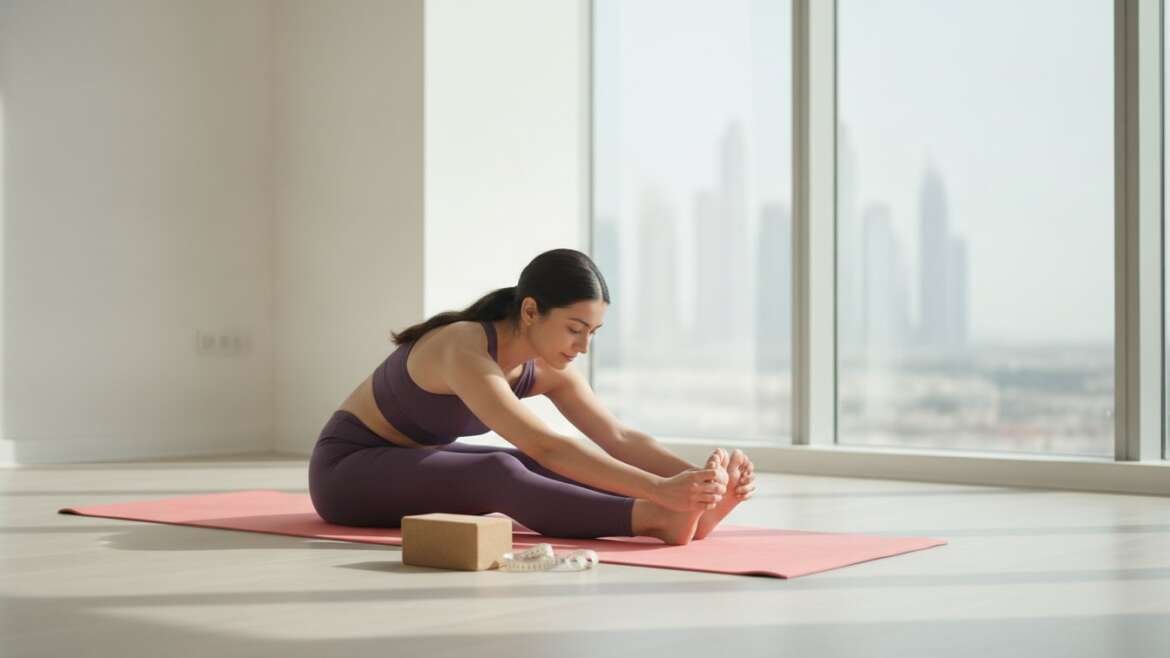
- Distance Measurements: Use a simple tape measure for specific postures. In a seated forward fold, you can measure the distance between your fingertips and your toes or the crown of your head and your shins.
- Breath Capacity: Track the number of calm, steady breaths you can hold in a challenging position. Increasing your duration from five to ten breaths while maintaining integrity is a significant marker of nervous system adaptation.
- Joint Angles: Use simple smartphone apps designed for range-of-motion tracking. These tools allow you to measure the specific angle of your hips or shoulders, providing a professional level of insight into your anatomical progress.
Soft Metrics: The Sensations
While numbers tell one story, your internal experience tells another. Measuring progress in flexibility with yoga must include an assessment of how your body feels from the inside out. This qualitative approach fosters a deeper connection with your physical self.
- Perceived Level of Tension: On a scale of 1 to 10, how much resistance do you feel in a pose? A drop from an 8 to a 5 over several weeks is a profound victory, even if your physical depth hasn’t changed.
- Quality of Recovery: Note how you feel the morning after a session. As you progress, you’ll likely find that “next-day stiffness” diminishes, replaced by a sense of lingering vitality and ease.
- Daily Mobility: Pay attention to mundane movements. You might suddenly realize it’s easier to reach for a seatbelt, tie your shoes, or look over your shoulder while driving. These real-world improvements are the ultimate goal of a functional yoga practice.
How to Measure Your Flexibility: A Step-by-Step Home Audit
Stability is the foundation of accurate assessment. To ensure your data is reliable, you must create a consistent testing environment. We recommend performing your audit on the same mat, in the same room, and at the same time of day. This eliminates variables like floor texture or varying levels of daily inflammation. Measuring progress in flexibility with yoga is most effective when you distinguish between a “Cold Test” and a “Warm Test.” A cold test, taken before any movement, reveals your functional baseline for daily life. A warm test, performed after a full session, shows your body’s current peak potential. Both metrics are valuable, provided you don’t confuse one for the other.
We suggest conducting this audit every four weeks. Testing more frequently can lead to an obsession with millimeters, which detracts from the serenity of the practice. Use your props as tangible milestones. If you previously needed two blocks for support and now only need one, that is a measurable victory of increased elasticity. If you want to refine your technique and track these changes with expert eyes, our private Yoga instruction can help you establish these professional benchmarks safely.
The Three Benchmark Poses
- Uttanasana (Standing Forward Fold): Stand with feet hip-width apart. Fold forward and measure the distance between your fingertips and the floor. If you can touch the floor, note whether you’re using fingertips, knuckles, or palms.
- Anjaneyasana (Low Lunge): Lower your back knee to the mat. Focus on the opening of the rear hip flexor. Use a yoga block next to your front foot as a reference point for how deep your hips sink toward the earth.
- Gomukhasana (Cow Face Pose): Reach one arm over your shoulder and the other behind your back. Note the gap between your fingers. This assesses shoulder mobility and often reveals surprising asymmetries between your dominant and non-dominant sides.
The Photo Protocol
Visual evidence is a powerful motivator. To capture high-quality data, set your camera at hip height on a tripod or stable surface. Always take side-profile shots to see the curvature of the spine and the tilt of the pelvis. Wearing the same yoga attire for every session ensures that fabric folds don’t obscure your alignment. Many modern smartphone apps offer “Grid” overlays. Use these lines to see subtle shifts in your spinal alignment or the depth of your folds that the naked eye might miss. Measuring progress in flexibility with yoga through this structured approach brings professional reliability to your personal home sanctuary.
Accelerating Milestones through Personalised Private Instruction
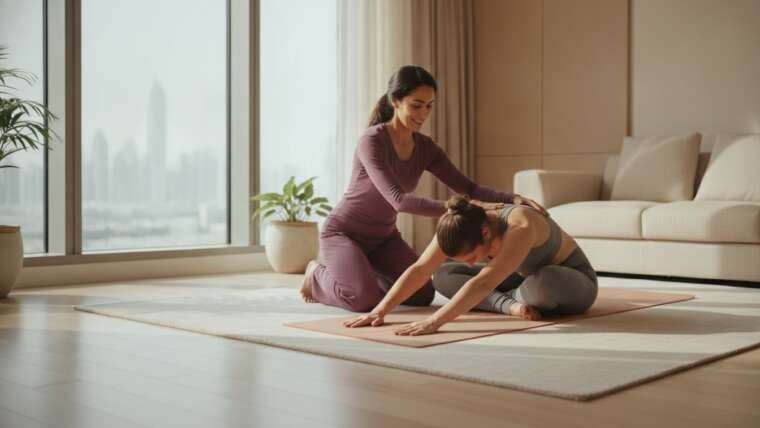
While a home audit provides a necessary baseline, the presence of a certified mentor offers a level of precision that solo practice simply cannot reach. We all have physical “blind spots”—habitual patterns where we unknowingly compensate for tightness by misaligning another part of our structure. An experienced teacher identifies these subtle shifts immediately, ensuring your effort translates into actual opening rather than strain. Measuring progress in flexibility with yoga becomes a much more efficient process when you have a professional partner to navigate the nuances of your unique anatomy.
Safety is the cornerstone of any restorative journey. Professional adjustments provide the gentle resistance or support needed to find your “sweet spot” without the risk of overstretching. These bespoke sessions allow us to create programmes that target specific needs, such as improving your back health through carefully curated spinal movements. Beyond the physical, private yoga instruction offers a high degree of accountability. It ensures that your practice remains a consistent priority, even during those weeks when life feels cluttered and your motivation begins to wane.
The Role of the Expert Eye
A teacher notices the “micro-progressions” that you might easily overlook. You may not feel like you’ve moved closer to the floor, but your mentor sees the subtle release in your shoulders or the newfound stability in your pelvis. These small victories are the precursors to advanced variations. We customise the pace of every session to match your unique physiological rhythm, ensuring you never feel rushed or held back. This transition from corrective poses to more fluid expressions of movement is a sign of a maturing, healthy body.
Creating a Restorative Sanctuary at Home
There is a profound psychological advantage to practicing in your own serene environment. By removing the “comparison trap” found in public studio settings, you can focus entirely on your internal experience. Measuring progress in flexibility with yoga in a familiar space allows your nervous system to drop into a deeper state of relaxation. This tranquility is essential for the fascial remodeling we discussed earlier. When you eliminate the pressure to perform for others, every session becomes a genuine step toward holistic transformation and a more sustainable way of life.
Embracing Your Journey Toward Lasting Serenity
True transformation is a quiet, steady process that begins deep within the nervous system. By shifting your focus from the final pose to the quality of your breath and the ease of your movement, you cultivate a practice that is both sustainable and profoundly restorative. We’ve explored how a dual-tracking framework, combining objective data with mindful awareness, ensures that measuring progress in flexibility with yoga becomes a source of inspiration rather than frustration. Whether you’re performing a home audit or noticing the gradual remodeling of your fascia, every session is a testament to your commitment to holistic well-being.
You don’t have to navigate this path alone. Our REPS UAE and Yoga Alliance Certified Instructors bring professional wellness directly to your home or office, offering specialised programmes for ladies, seniors, and prenatal care. We provide the expert eye and compassionate guidance needed to identify your unique physiological rhythms and safely accelerate your milestones. Begin your personalised journey to flexibility with a private session and discover the tranquility that comes with a body in balance. Your path from stiffness to serenity is a way of life, and we’re honored to be your supportive partner in this restorative process.
Frequently Asked Questions
How long does it take to see noticeable progress in flexibility?
You’ll typically notice subtle shifts in your nervous system within four to six weeks of consistent practice. While your physical reach might not change overnight, the perceived “ease” of a pose usually improves first. Significant fascial remodeling and structural changes generally require three to six months of dedicated effort. Measuring progress in flexibility with yoga is a long-term commitment to your body’s restorative rhythm rather than a quick fix for stiffness.
Why do I feel more flexible on some days and stiffer on others?
Your body’s elasticity fluctuates based on hydration, sleep quality, and your current stress levels. High cortisol causes muscles to remain in a vigilant, contracted state, while dehydration makes connective tissues more brittle. Temperature also plays a role; you’ll naturally feel more supple in the evening than during the “morning stiffness” baseline. These variations are normal parts of your physiological landscape and shouldn’t be seen as a lack of progress.
Can I measure my flexibility without using any special equipment?
You can accurately assess your range of motion using simple body markers as your guide. Note whether your fingertips reach your shins, ankles, or the floor during a forward fold. You might also track the distance between your hands in a bind or the position of your knees in a seated pose. These internal benchmarks provide a reliable way of measuring progress in flexibility with yoga without needing any specialized tools or technology.
Is it possible to become ‘too flexible’ through yoga practice?
It’s possible to develop hypermobility, which is flexibility without the necessary muscular strength to support the joints. Yoga should always be a balance of stability and ease. If you only focus on lengthening without building the strength to control those new ranges, you increase the risk of ligament strain. A well-rounded practice includes active engagement to ensure your joints remain safe and supported as they open.
What is the best time of day to accurately test my flexibility?
The best time to test is whenever you can be most consistent for every future audit. Many practitioners prefer the late afternoon or early evening when the body is at its natural peak temperature and suppleness. However, if you choose to test in the morning to find your “cold baseline,” ensure you always test at that same hour. Consistency is more important than the specific time you choose for your assessment.
How often should I conduct a formal flexibility audit?
We recommend conducting a formal flexibility audit once every four weeks. This timeframe is long enough to allow for genuine physiological changes in your fascia and nervous system to take place. Testing more frequently can lead to frustration or an unhealthy obsession with minor daily fluctuations. By waiting a month between audits, you’ll see a clearer, more encouraging picture of your long-term transformation toward a state of serenity.
Does age significantly impact how fast I can improve my range of motion?
Age does influence the speed of change because connective tissues naturally lose some hydration and elasticity over time. However, practitioners over the age of 50 often see significant improvements in mobility and a reduction in chronic aches with a patient, consistent practice. While your journey might move at a different pace than a younger student’s, the restorative benefits of yoga remain accessible and deeply transformative at every stage of life.
What should I do if my flexibility progress seems to have plateaued?
If your progress feels static, it’s often a sign that your body has adapted to your current routine and needs a new stimulus. Try shifting your focus to different styles, such as moving from Hatha Yoga to more restorative poses, or deepening your breath work to further calm the nervous system. Seeking a private mentor to identify subtle alignment “blind spots” can also provide the breakthrough needed to move past a physical or mental plateau.