Believing you must be flexible to practice yoga is like believing you must be fit to join a gym. It’s a common misconception that keeps many people stuck in a cycle of chronic stiffness and office-related tension. If you’ve been wondering how to start yoga if you are not flexible, the truth is that your current limitations are exactly why you should begin. You aren’t “bad” at yoga because you can’t reach your feet; you’re simply at the beginning of a restorative process that prioritizes your personal growth over physical perfection.
We understand the fear of feeling out of place in a crowded class or the worry of causing an injury by pushing too hard. This guide promises to shift your perspective, showing how yoga is a bespoke journey toward mental clarity and physical ease rather than a performance. You’ll discover how to safely modify poses for your unique body and why starting in the comfort of your own home is often the most effective way to build confidence. We’ll explore practical steps to improve your mobility and reduce stress, helping you feel truly comfortable in your own skin.
Key Takeaways
- Understand that flexibility is a natural outcome of practice rather than a requirement for your very first session.
- Learn how gentle, consistent movement communicates with your nervous system to safely thaw chronic stiffness and muscular tension.
- Discover how to start yoga if you are not flexible through private home sessions that eliminate the pressure and judgment of a public studio.
- Identify how simple props like blocks and bolsters can bridge the gap between your body and the floor for a more supportive experience.
- Realize the benefits of working with certified mentors who provide personalized adjustments tailored specifically to your unique physical needs.
The Great Flexibility Myth: Why You Don’t Need to Be Flexible to Start Yoga
Health is a state of internal balance, yet many believe they must achieve a certain physical standard before they can even begin to seek it. This is the great irony of the flexibility myth. If you are researching how to start yoga if you are not flexible, you’ve likely seen images of practitioners in complex, pretzel-like shapes. However, yoga is fundamentally a practice of awareness, not a performance of acrobatics. It’s an internal dialogue between your mind and your muscles where the goal is presence, not perfection.
Centuries ago, physical postures were developed primarily to prepare the body for long periods of seated meditation. The objective wasn’t to achieve a specific aesthetic or to reach a certain degree of spinal extension. Instead, the practice focused on creating a stable, comfortable vessel for mental clarity. Think of yoga like learning a new language. You wouldn’t expect to be fluent in a foreign tongue before your very first lesson. Similarly, you don’t need to be flexible to step onto a mat. You start exactly where you are, using the union of breath and movement to explore your current range of motion with kindness and curiosity.
Where Did the ‘Bendy’ Stereotype Come From?
The rise of social media has significantly skewed our perception of modern postural yoga. High-definition photos of hypermobile individuals often dominate the digital landscape, leading beginners to believe that being “bendy” is the only way to belong. There is a vital distinction between hypermobility, which is often a genetic trait of the joints, and functional flexibility, which is the healthy range of motion needed for daily life. Yoga is a tool for restorative health rather than an athletic competition.
The ‘Toe-Touch’ Test: Why It Doesn’t Matter
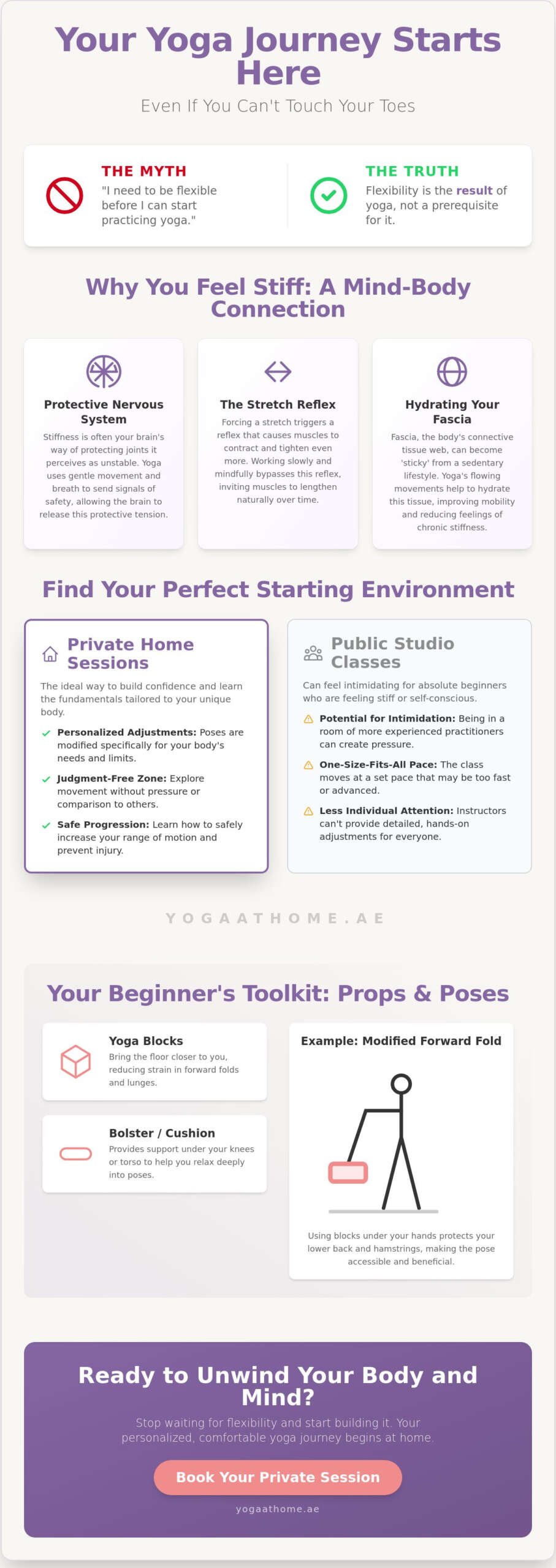
Many people avoid the mat because they can’t touch their toes, but this specific metric doesn’t define your potential for progress. Your current stiffness is actually a protective mechanism. Your nervous system often tightens muscles to protect joints it perceives as unstable or under stress from office work. When considering how to start yoga if you are not flexible, it helps to distinguish between bone-on-bone tension, which is a structural limit, and muscle tightness, which is a soft-tissue state we can influence. Your current range of motion isn’t a barrier; it’s the perfect baseline for a personalized journey toward a more supple and relaxed body.
How Yoga Gradually Unlocks Your Body’s Natural Range of Motion
Flexibility is often misunderstood as a purely mechanical property of the muscles. In reality, it’s a neurological negotiation between your brain and your body. When you explore how to start yoga if you are not flexible, you’re essentially teaching your nervous system to feel safe in new positions. Stiffness is frequently a “holding pattern” created by the brain to protect the body from perceived threat or instability. By approaching movement with patience, you signal that it’s okay to let go of this protective tension.
The breath, or Pranayama, serves as the bridge in this communication. Deep, rhythmic exhales signal the parasympathetic nervous system to downregulate the “fight or flight” response. This physiological shift allows the muscles to physically soften. If you attempt to force a stretch through sheer willpower, you trigger the stretch reflex. This is a survival mechanism that causes muscles to contract sharply to prevent tearing. Forcing a pose doesn’t just cause pain; it actually makes you more inflexible over time as the brain learns to associate stretching with danger.
Understanding Fascia and Muscle Spindles
Fascia is the body’s internal webbing, a vast network of connective tissue that surrounds every muscle, bone, and organ. In a sedentary lifestyle, fascia can become dehydrated and “sticky,” which leads to that familiar feeling of chronic stiffness. Yoga acts as a hydration system for this tissue. By moving slowly through a beginner’s yoga flow, you gently glide these layers of tissue against one another. This movement encourages fluid to return to the fascia, allowing for smoother, pain-free motion. Slow, deliberate transitions are essential for beginners because they bypass the jumpy “muscle spindles” that want to snap the muscle back to its original length.
Hatha Yoga: The Ideal Foundation for Inflexible Beginners
For those navigating limited mobility, Hatha Yoga provides a superior starting point compared to fast-paced, athletic flows. Hatha focuses on physical alignment and holding poses for longer durations. These extended holds are necessary to reach the deeper layers of connective tissue that short stretches simply cannot influence. This style also emphasizes building the functional strength required to support your expanding range of motion. A supple body must also be a strong one to remain injury-free. If you’re ready to begin this restorative process, our instructors offer private yoga lessons designed to meet you exactly where your body is today.
Private Home Sessions vs. Public Studios: Choosing the Right Path
Wellness is a deeply personal journey that flourishes best in an environment of safety and stillness. For many beginners, the bright lights and mirrored walls of a public studio can feel like a stage rather than a sanctuary. If you’ve been searching for how to start yoga if you are not flexible, the privacy of your own living room provides the perfect laboratory for self-discovery. Practicing in a private setting eliminates the “comparison trap,” where the urge to match a neighbor’s depth of stretch often leads to overexertion and frustration. Instead of performing for a room, you focus entirely on the internal sensations of your own body.
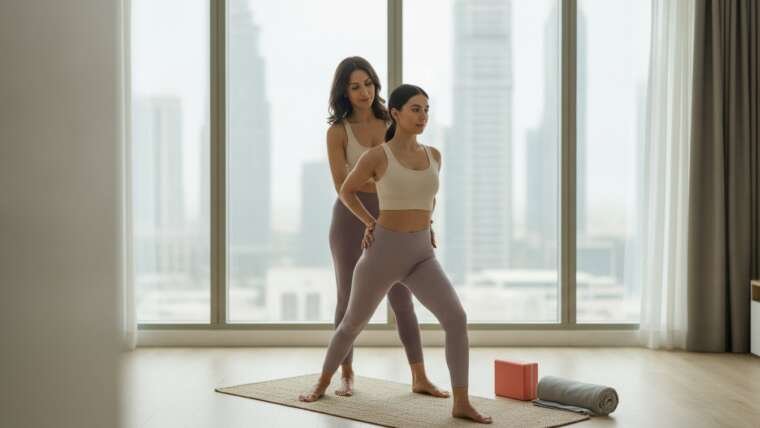
Personalized pacing is the cornerstone of a successful private practice. In a group class, the teacher must cater to the “average” ability of twenty different people, which often leaves very stiff practitioners feeling left behind or rushed through transitions. A private session moves at the exact speed of your body’s needs. If a particular area feels especially tight, your instructor can pause, offer a modification, and allow you the time to breathe into the tension. This bespoke approach ensures that you are never forced into a shape that your body isn’t ready to hold, making the practice a restorative process rather than an intimidating chore.
The Safety Advantage of One-on-One Instruction
Safety is not just about avoiding pain; it’s about respecting the unique skeletal structure you were born with. Every individual has different hip socket depths and spinal proportions that dictate their natural range of motion. A private instructor provides immediate, safe adjustments that are tailored to these specific physical realities. They take the time to understand your medical history and identify chronic “tight spots” caused by years of office work or old injuries. Tailored verbal cues and hands-on adjustments ensure your body finds its optimal alignment immediately, accelerating your progress far beyond the reach of generic group instructions.
Integrating Yoga into Your National Lifestyle
The modern lifestyle demands both efficiency and respect for personal boundaries. Mobile yoga professionals remove the barrier of the studio commute, bringing the practice directly to your home or office. This convenience makes it significantly easier to build a sustainable habit, especially when you are learning how to start yoga if you are not flexible and need consistent, low-stress sessions. Private instruction also respects important cultural preferences. For instance, many women prefer the comfort of Ladies Yoga sessions with female trainers in a secure, private environment. By removing the logistical and social hurdles of a public gym, you create a space where true transformation can unfold naturally.
Gentle Starting Points: Poses and Props for the Stiff Body
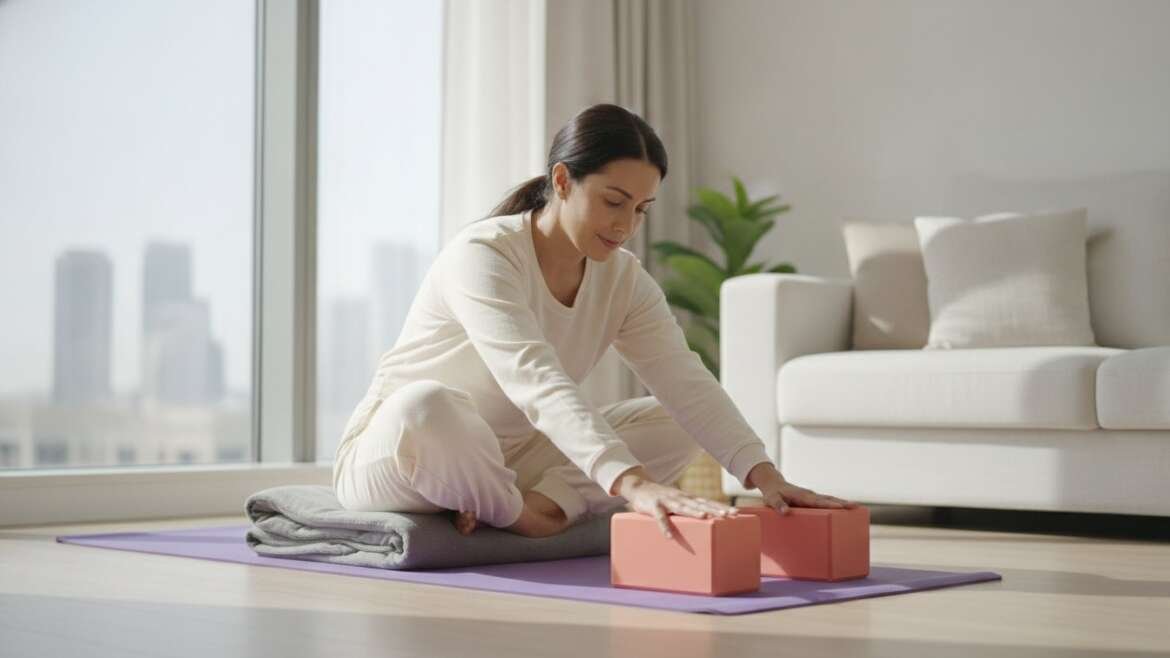
True wellness begins when we stop fighting our bodies and start supporting them. When exploring how to start yoga if you are not flexible, many beginners assume they must force themselves into rigid shapes. However, the most effective practice is one that uses props to bridge the gap between your current reach and the floor. Yoga blocks and straps aren’t crutches; they’re essential tools that “bring the floor to you,” allowing you to maintain proper alignment without straining. By using a block under your hand in a standing pose, you preserve the length of your spine instead of collapsing just to reach the ground.
Restorative support is equally vital for those dealing with chronic stiffness. Bolsters and folded blankets provide a firm yet gentle foundation that allows the nervous system to truly relax. In almost every forward-folding pose, bent knees are a beginner’s best friend. Keeping the knees soft protects the lower back and shifts the focus away from the “hamstring obsession” that often causes injury. Instead of fixating on a deep stretch, we focus on “opening” the hips and chest. This creates space for deeper breathing and releases the tension often held in the upper body from hours of screen time. If you’re ready to experience this supportive approach, consider booking a session for Yoga for back pain to begin your healing journey.
Modified Poses for Immediate Relief
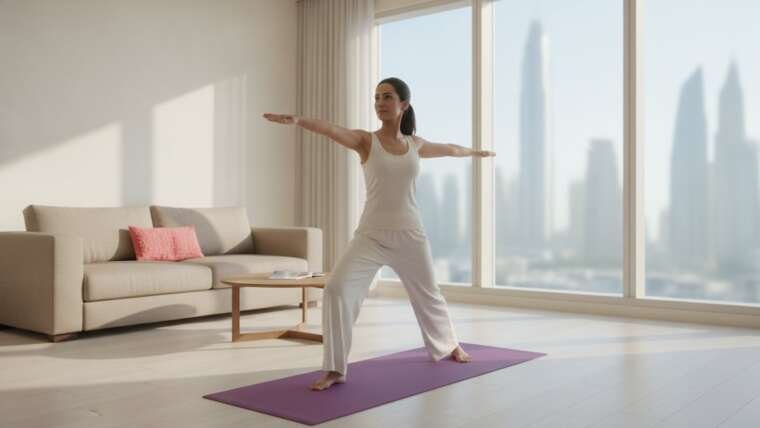
We begin with Tadasana, or Mountain Pose, which focuses on grounding through the feet and finding effortless spinal length. It’s the foundation of all standing postures. For those seeking relief from spinal tension, a modified Bhujangasana (Cobra Pose) is highly effective. Instead of pushing high, we keep the elbows tucked and the lift very slight to avoid pinching the lower back. Balance can also be a challenge initially. Using a sturdy chair for support during balance poses builds the necessary confidence and strength without the fear of falling.
The Importance of Proprioception
Mindful movement is as much about the brain as it is about the muscles. Proprioception is your body’s ability to sense its position in space, and yoga helps you develop a detailed “body map.” This awareness allows you to identify where you’re holding unconscious tension, such as a clenched jaw or hiked shoulders. For our elders, this improved coordination is vital for maintaining independence and preventing falls. Our specialized Yoga for Seniors focuses on these functional movements. A key part of this journey is learning to distinguish between “good” discomfort, which is the sensation of a muscle awakening, and “bad” pain, which is a sharp signal to back off and rest.
Personalized Wellness with Yogaathome: Your Journey to a Supple Body
Health is the foundation of a vibrant life, yet the path toward it should never feel like a burden. At Yogaathome, we are committed to providing a serene and professional environment where your personal growth is the only priority. If you’ve been hesitant about how to start yoga if you are not flexible, our approach removes the pressure of performance. Every session is led by highly qualified instructors holding REPS UAE and Yoga Alliance certifications. These credentials ensure that your practice is grounded in modern safety standards while honoring the ancient roots of the discipline.
We don’t believe in one-size-fits-all fitness. Our trainers specialize in diverse demographic needs, offering everything from prenatal support to targeted relief for chronic stiffness. For those in their golden years, our Yoga for Seniors program emphasizes functional mobility and joint health. By tailoring every movement to your unique physical goals and current emotional state, we transform a simple exercise routine into a bespoke wellness journey that honors your body’s specific requirements.
A Restorative Approach to Modern Living
Our philosophy extends beyond physical postures to encompass a total holistic transformation. We combine mindful movement with meditation to help you achieve mental clarity alongside internal balance. Our trainers act as compassionate mentors, helping you navigate the mental barriers that often arise when you are learning how to start yoga if you are not flexible. The convenience of doorstep delivery means your wellness routine fits seamlessly into your schedule; your home becomes the ultimate sanctuary for restoration without the stress of a commute.
Begin Your Transformation Today
The year 2026 offers a fresh opportunity to prioritize your mobility and nervous system health. Starting is as simple as booking your first private session, where your instructor will assess your needs and create a roadmap for your growth. You’ll find that our instructors are patient, grounded, and focused on your long-term well-being rather than quick fixes. You don’t need to wait until you are “ready” or “more flexible” to begin. Your body is a perfect starting point exactly as it is today, and we are here to support every step of your journey toward a more supple and grounded version of yourself.
Embrace Your Journey Toward Lasting Tranquility
True transformation begins the moment you accept that your current physical state is the perfect starting point. You’ve learned that flexibility is an inevitable reward of practice, not a barrier to entry. By understanding how your nervous system responds to safety and why props are essential tools for alignment, you’re now equipped with the knowledge of how to start yoga if you are not flexible. This journey is about reclaiming your internal balance and mental clarity in the comfort of your own sanctuary.
Our team of REPS UAE and Yoga Alliance certified instructors is dedicated to providing a bespoke experience that respects your goals. We offer specialized Ladies-only programs with female trainers and deliver our restorative services directly to your home or office. Book your personalized private yoga session today and start your journey to a more flexible you. Your body is ready for this change exactly as it is. We’re here to guide you toward a life of greater ease and sustainable well-being.
Frequently Asked Questions
Is it possible to do yoga if I can’t touch my toes?
Touching your toes is a result of consistent practice, not a requirement to begin your journey. Yoga is designed to meet you exactly where you are, regardless of your current reach or range of motion. Many practitioners start with their hands on their shins or use blocks to bring the floor closer to them, which allows the body to open safely and without strain.
The goal is to experience a gentle release in the muscles and a sense of presence in the breath. Whether your fingers reach your knees or the floor, the physiological and mental benefits remain the same. Over time, as your nervous system learns to relax, you’ll find that your reach naturally extends further.
How often should a beginner practice yoga to see improvements in flexibility?
Practicing two to three times per week is the ideal frequency for beginners to see sustainable progress. Consistency is far more important than intensity when you’re learning how to start yoga if you are not flexible. This rhythm gives your connective tissues and nervous system enough repetition to adapt without causing physical exhaustion or overtraining.
Shorter, more frequent sessions are often more effective than one long, intense class. By returning to the mat regularly, you signal to your brain that these new ranges of motion are safe. This consistent communication helps to “thaw” chronic stiffness and build a foundation of functional mobility that lasts a lifetime.
Will I hurt my back if I try yoga while being very stiff?
Yoga is a safe and highly effective tool for spinal health when practiced with proper alignment and mindfulness. Stiffness is often the body’s way of protecting itself, so the key is to move gently and never force a position. Keeping your knees bent in forward folds and using props for support ensures that the stretch stays in the muscles rather than pulling on the lower back.
Working with a certified instructor is the best way to prevent injury. They provide personalized adjustments that respect your skeletal structure and current limitations. By focusing on spinal length and core stability, yoga actually helps to alleviate the muscular tension that often leads to back pain in the first place.
What should I wear for my first private home yoga session?
You should wear comfortable, breathable clothing that allows for a full range of motion. Leggings, joggers, or flexible athletic shorts paired with a t-shirt that isn’t too loose are excellent choices. Since you’re practicing in the privacy of your own home, there’s no need for expensive, high-performance gear; the focus is entirely on your comfort and ease of movement.
It’s best to avoid clothing with restrictive waistbands or heavy zippers that might dig into your skin during seated or reclining poses. Most practitioners prefer to practice barefoot to ensure a firm grip on the mat and better stability. The most important factor is that you feel relaxed and unhindered by what you’re wearing.
Can seniors with limited mobility still benefit from yoga?
Seniors can experience life-changing benefits from yoga, even if they have significant mobility challenges. A tailored practice helps to maintain joint health, improve balance, and enhance the coordination necessary for daily activities. Our specialized programs focus on gentle movements that respect the body’s boundaries while encouraging a restorative process of physical and mental well-being.
By using chairs or other props, we make every pose accessible and safe. This inclusive approach ensures that the practice remains non-intimidating and supportive. Beyond the physical improvements, many seniors find that the focus on deep breathing and mindfulness provides a profound sense of tranquility and mental clarity.
Do I need to buy expensive equipment to start yoga at home?
You don’t need a large investment to begin a successful home practice. A high-quality, non-slip yoga mat is the only essential piece of equipment, as it provides the necessary cushioning and stability for your joints. Other helpful tools, such as blocks or straps, can often be improvised with common household items like thick books or a sturdy belt.
As you progress, you might choose to invest in professional props to enhance your comfort, but they aren’t a prerequisite for your first session. Our instructors are experts at helping you use your environment effectively. The most valuable “equipment” you bring to the mat is your own breath and a willingness to explore your body’s potential.
How long does it take to feel ‘flexible’ after starting yoga?
Most practitioners notice an immediate sense of mental ease, while physical changes typically begin to manifest within four to six weeks of regular practice. Flexibility is a gradual unfolding rather than a sudden shift. You’ll likely notice “micro-wins” first, such as feeling less stiff when waking up or finding it easier to sit comfortably on the floor.
Every body follows its own unique timeline for change. Factors like your hydration levels, stress, and previous activity levels all play a role in how quickly your tissues respond. The key is to remain patient and celebrate the increased sense of space and ease you feel in your body, rather than focusing on a specific destination.
Can yoga help with chronic stiffness caused by office work?
Yoga is specifically designed to counter the physical toll of a sedentary, digital lifestyle. It targets the “tech neck” and tight hip flexors that result from hours of sitting at a desk. Learning how to start yoga if you are not flexible allows you to introduce movements that actively reverse these patterns, opening the chest and lengthening the spine.
Regular practice helps to rehydrate the fascia that becomes “stuck” during long periods of inactivity. By incorporating mindful stretches and strengthening poses, you can significantly reduce the tension held in your shoulders and back. This not only improves your posture but also leads to higher energy levels and reduced discomfort throughout your workday.