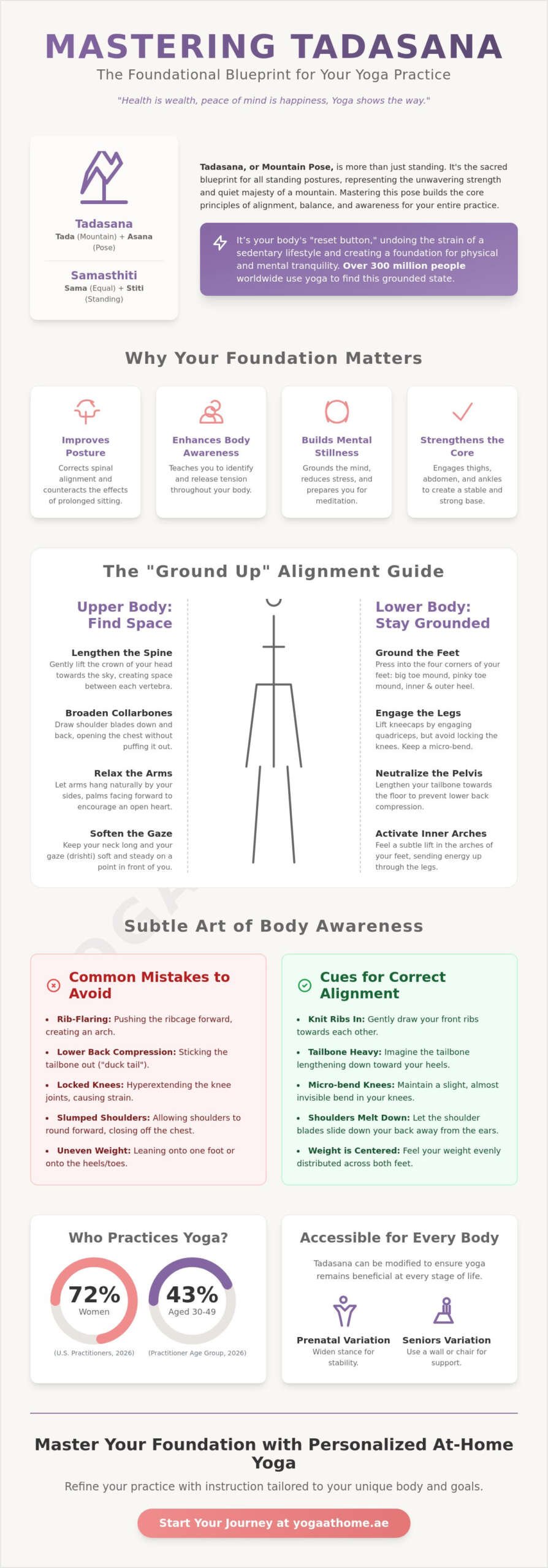
Tadasana is not just standing; it’s a conscious engagement of the entire body that builds the blueprint for all wellness. Health is wealth, peace of mind is happiness, and Yoga shows the way. If you spend your hours hunched over an office desk, you likely feel the strain in your spine and a nagging sense of physical instability. It’s common to feel overwhelmed by complex poses when you simply want to feel grounded and at ease. You aren’t alone in this search for balance. With 43% of practitioners now between the ages of 30 and 49, more people than ever are turning to yoga to manage high stress, digital lifestyles in 2026.
By mastering tadasana, or Mountain Pose, you’ll reclaim your natural alignment and find the inner tranquility that over 300 million people worldwide seek. This foundational asana offers more than just a physical stretch; it’s a nurturing step in a healing journey toward better balance and vitality. In this guide, you’ll discover the precise techniques to transform your posture, stabilize your core, and create a strong foundation for a lifelong yoga practice that is accessible, personalized, and non-intimidating for everyone.
Key Takeaways
- Understand how tadasana serves as the sacred blueprint for all standing postures, providing a stable foundation for your entire Hatha Yoga practice.
- Master the “ground up” alignment technique to improve your posture and create a sense of inner tranquility that lasts long after you leave your mat.
- Learn to identify and fix common mistakes like rib-flaring and lower back compression to ensure a safe and supportive healing journey.
- Discover personalized variations designed specifically for seniors and expectant mothers, ensuring that yoga remains accessible and beneficial at every stage of life.
- Explore the unique advantages of tailored, home-based instruction to refine the subtle body awareness needed for true physical and mental transformation.
What is Tadasana? Understanding the Sacred Mountain Pose
Health is wealth, peace of mind is happiness, and Yoga shows the way. This mantra guides every movement on the mat, starting with the most fundamental posture of all. In the practice of Hatha Yoga, Tadasana (Mountain Pose) is more than just standing still. The name comes from the Sanskrit words “Tada,” meaning mountain, and “Asana,” meaning seat or posture. It represents the unwavering strength and quiet majesty of a peak that remains unmoved by the shifting winds around it.
Tadasana is the foundational alignment pose for spinal health, acting as the primary reset for the body’s vertical axis. Think of it as the blueprint for every other standing pose in your practice. If your alignment is off here, that imbalance will travel into your triangles, warriors, and balances. By mastering this pose, you’re learning how to engage your muscles efficiently and stack your bones in a way that minimizes strain. With over 300 million people practicing yoga worldwide in 2026, many are discovering that this simple posture is the key to undoing the damage of a sedentary lifestyle.
The Etymology and Spiritual Origins
In many traditions, this pose is also called Samasthiti. “Sama” means upright, straight, or equal; “Stiti” means standing or togetherness. This concept of equal standing refers to the balanced distribution of weight across both feet. In our Sivananda Yoga and Hatha practices, we view this as a moment of profound centering. It aligns with our philosophy that wellness is a holistic journey. When you stand in tadasana, you aren’t just adjusting your shoulders. You’re inviting a sense of inner tranquility that prepares you for the day’s challenges.
Why Foundation Matters in Your Yoga Journey
You wouldn’t build a house on a shifting sand dune. A weak foundation leads to cracks in the walls, and the same logic applies to your body. Skipping the basics of standing can lead to joint pain or recurring injuries. Tadasana teaches you the subtle art of body awareness, showing you where you hold tension and where you lack strength. We believe that Yoga is Possible for Anyone, and that accessibility starts with a firm, grounded base.
This physical grounding has a direct impact on your mental state. As you root your feet into the earth, you’re training your mind to find stillness amidst the chaos of daily life. It’s a vital preparation for pranayama and meditation. Research from April 2026 shows that 72% of practitioners in the U.S. are women, many of whom use these foundational poses to regulate their nervous systems after high-stress workdays. Standing tall isn’t just about height. It’s about claiming your space and finding peace within your own skin.
Step-by-Step Guide: How to Perform Tadasana with Perfect Alignment
Health is wealth, peace of mind is happiness, Yoga shows the way. While many believe standing is a passive activity, true tadasana requires an active, conscious engagement of the entire musculoskeletal system. Practicing in your own sanctuary eliminates the distractions of public classes, allowing you to focus deeply on these internal adjustments. With 36 million yoga practitioners in the U.S. alone, discovering the strength in stillness has become a global priority for those seeking physical and mental alignment. Learning how to do Mountain Pose with precision is the first step in your personal healing journey toward vitality.
Finding Your Center: The Lower Body
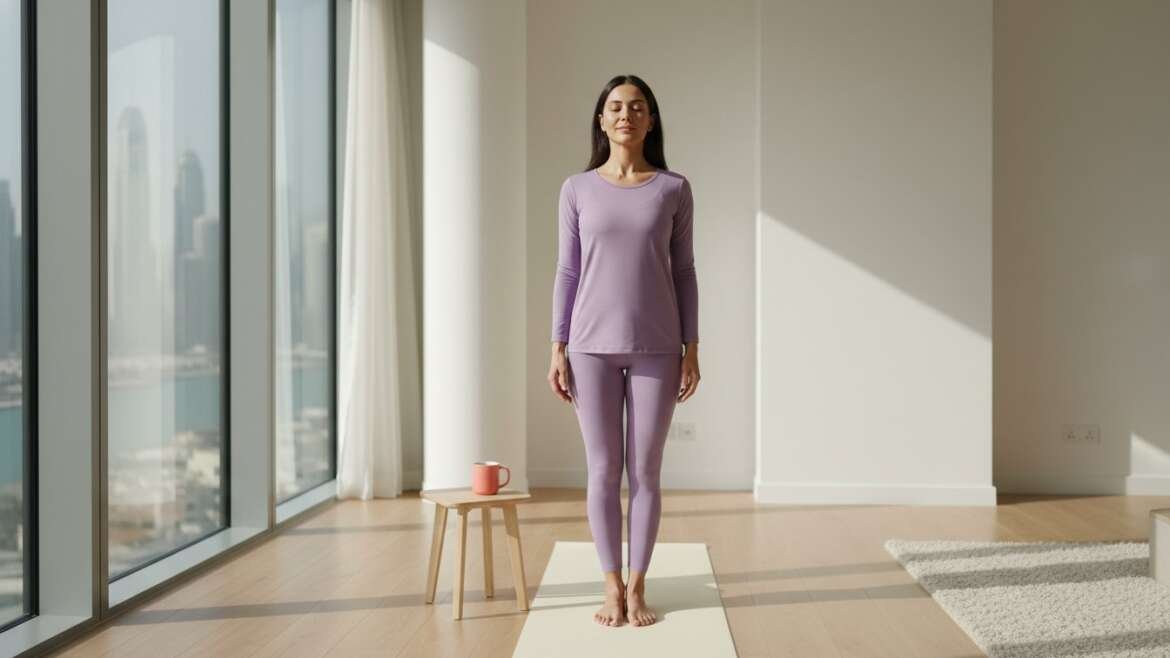
Alignment begins where you meet the earth. Stand with your big toes touching and your heels slightly apart; this creates a parallel line between the outer edges of your feet. Press down firmly through the “four corners”: the mound of the big toe, the mound of the pinky toe, the inner heel, and the outer heel. As you root down, feel the inner arches of your feet lift, sending energy up through the inner ankles. Engage your quadriceps to lift the kneecaps, but don’t lock your joints. This subtle activation protects your knees while building strength. To neutralize the pelvis, imagine your tailbone lengthening toward your heels without aggressively tucking it. This simple shift prevents the “duck tail” posture that often leads to lower back compression.
Opening the Heart: The Upper Body
As the lower body provides stability, the upper body seeks space and breath. Draw your shoulder blades down and back, feeling your collarbones broaden and your heart space open. Your arms should rest naturally at your sides with the palms facing forward or toward the thighs; choose the variation that feels most expansive for your chest. Imagine a luminous, invisible string attached to the crown of your head, gently drawing your spine toward the heavens to create effortless length in your neck. This visualization helps you maintain a neutral cervical spine, keeping your chin parallel to the floor rather than tilting up or down. If you find these subtle shifts difficult to master alone, consider the benefits of private hatha yoga instruction to receive personalized guidance tailored to your unique body structure.
Maintain this active posture for five to ten deep breaths. Focus on the sensation of being both rooted like a mountain and light like the air. By consciously engaging these muscle groups, you transform a simple standing position into a powerful tool for stress reduction and spinal health. This practice isn’t about rigid perfection; it’s about nurturing a sustainable, lifelong approach to well-being that starts from the ground up.
Common Mistakes and the Subtle Art of Body Awareness
Health is wealth, peace of mind is happiness, Yoga shows the way. Many practitioners approach tadasana as a simple rest period between more strenuous asanas, but this is a missed opportunity for profound transformation. There’s a significant distinction between merely standing and consciously practicing. When you stand passively, your joints often lock and your mind wanders. When you practice Mountain Pose, you’re engaging in a full body scan that reveals exactly where your body holds stress and where it lacks support.
The most frequent error is rib-flaring. This happens when you lift your chest but allow your front ribs to jut out, which creates unnecessary compression in the lower back. To fix this, imagine knitting your front ribs toward your hip bones while maintaining a broad collarbone. Another common issue is uneven weight distribution. Data from biomechanical studies in early 2026 suggests that most office workers lean too far into their heels, which disengages the core muscles. You should feel an even pressure across the entire foot, ensuring your center of gravity remains perfectly stable.
Correcting Postural Imbalances at Home
Your home environment offers unique tools for refinement. Use a flat wall as a silent teacher to check your vertical alignment. Stand with your heels, sacrum, and shoulder blades touching the surface. This immediately highlights “tech neck,” a condition affecting nearly 50% of digital professionals in 2026. By drawing the ears back over the shoulders, you counteract the forward leaning habits of desk work. Mastering this verticality provides the necessary foundation for more complex seated postures, such as Padmasana, where spinal integrity is paramount for comfort and meditation.
Breath and Energy: The Internal Practice
If you find yourself thinking, “I don’t feel anything in this pose,” it’s likely because the engagement is too superficial. Use your breath as an internal guide. Integrating a gentle Ujjayi breath or natural diaphragmatic rhythm helps you stay present and focused. As you inhale, feel the crown of your head reach higher. As you exhale, feel your feet root deeper into the earth. This rhythmic flow allows you to scan for hidden tension in the jaw or forehead. Keep your gaze, or Drishti, soft and level. Staring too hard or tilting the head creates neck strain, breaking the serene flow of energy you’re trying to cultivate. Once you’ve built this active awareness in standing poses, complementing your practice with essential yin yoga poses for deep restoration at home can help release the stubborn connective tissue tension that active asanas alone cannot fully address. Remember, Yoga is Possible for Anyone who is willing to look inward at these subtle, nurturing details.
Tadasana Variations for Every Body: Ladies, Seniors, and Prenatal
Health is wealth, peace of mind is happiness, Yoga shows the way. While the classic alignment discussed in previous sections provides a strong blueprint, true mastery involves adapting the practice to your body’s current needs. In 2026, the global yoga market is valued at $68.15 billion, reflecting a massive shift toward specialized, inclusive wellness. Whether you’re navigating the beautiful changes of pregnancy or seeking stability in your later years, tadasana can be tailored to support your unique healing journey. Our personalized home sessions ensure that every adjustment is nurturing and safe.
Ladies often prefer the privacy of their own sanctuary for these sensitive practices. Our female instructors provide a supportive environment where you can explore variations comfortably. Using props like blocks between the thighs can also help engage the inner legs more effectively, regardless of your experience level. This tailored approach ensures that tadasana remains a tool for empowerment rather than a source of frustration. To experience these specialized benefits in your own home, you can book a personalized session for ladies or seniors today.
Safe Prenatal and Post-natal Modifications
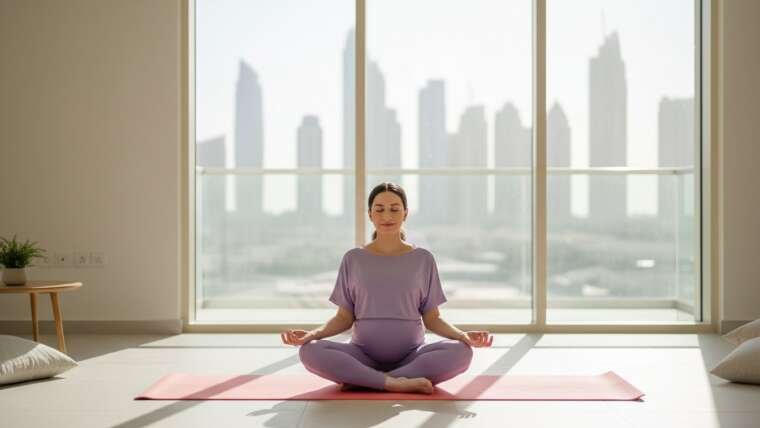
Expectant mothers often find their center of gravity shifting as the weeks progress. To accommodate a growing belly and maintain equilibrium, we recommend widening your stance to hip-width or even wider. This adjustment provides a more stable base and prevents strain on the lower back. Focusing on gentle pelvic floor stability and diaphragmatic breathwork helps prepare the body for childbirth and aids in post-natal recovery. If you feel any dizziness, which affects many practitioners during the second trimester, using a wall for support offers immediate security. This allows you to focus on the tranquility of the pose without the fear of losing your balance.
Yoga for Seniors: Building Stability and Confidence
For our senior practitioners, Mountain Pose is a vital tool for maintaining bone density and joint health. In the U.S., where 43% of practitioners are between 30 and 49, there’s a growing movement of seniors adopting yoga for longevity. A consistent standing practice strengthens the ankles and improves proprioception, which significantly reduces the risk of trips and falls. If standing for long periods feels challenging, a seated version using a chair provides the same spinal lengthening benefits. Pairing this active standing work with restorative yin yoga poses practiced at home offers seniors a well-rounded approach to joint health and flexibility. We believe that Yoga is Possible for Anyone, and these modifications ensure that the path to vitality remains open to all ages.
Mastering the Foundation with Personalized Private Yoga
Health is wealth, peace of mind is happiness, Yoga shows the way. While understanding the mechanics of tadasana is a vital first step, applying those principles to your specific anatomy requires a keen, expert eye. Group classes often fail to address the subtle misalignments that lead to long-term strain. In a room filled with twenty students, a teacher cannot possibly see if your weight is shifted two millimeters too far into your heels. Doorstep delivery brings the expertise of a sanctuary directly to your home, allowing for a level of focus and tranquility that public studios simply cannot match.
Practicing in your own space eliminates the “hustle” culture of the fitness industry. You don’t have to worry about traffic or crowded locker rooms. Instead, you can focus entirely on the nurturing journey of your own body. This personalized environment is where true transformation happens. Our instructors, such as Rajesh Sir or Nanthu Sir, respect your time and your spiritual growth, ensuring every session is punctual and tailored to your needs. From mastering the basics of Mountain Pose to progressing toward advanced yoga classes, a private mentor ensures your foundation is unshakable.
The Value of Expert Eyes and Hands-on Adjustments
Safety is our highest priority, which is why our trainers hold prestigious credentials from REPS UAE and Yoga Alliance. These certifications mean your instructor understands functional anatomy and trauma-informed teaching. A Wise Mentor doesn’t just call out poses; they build a relationship with you to understand your physical history. Many people believe they need a studio to stay motivated, but the opposite is often true. The accountability of a scheduled, one-on-one home visit provides a much stronger incentive to maintain a consistent routine. In 2026, where national averages for private sessions can range from $125 to $256, the value of bespoke instruction lies in preventing the injuries that DIY practice often causes.
Your Healing Journey Starts Here
Booking your first private session is a straightforward step toward vitality. When you invite a trainer into your home, you can expect a comprehensive assessment of your current posture and goals. We’ll look at how you stand in tadasana and identify the specific muscle groups that need strengthening or release. This isn’t a one-size-fits-all workout; it’s a sustainable approach to well-being that evolves with you. Whether you’re a senior looking for stability or a busy professional seeking stress reduction, we provide the tools for a rejuvenated life. Remember, Yoga is Possible for Anyone who is willing to take that first grounded step on their mat.
Step Into a Life of Balanced Vitality
Health is wealth, peace of mind is happiness, Yoga shows the way. You’ve learned how tadasana serves as the sacred blueprint for your physical alignment and mental clarity. By moving beyond passive standing to active engagement, you create a stable foundation that supports every other aspect of your wellness. Whether you’re navigating the unique needs of pregnancy or seeking to improve balance in your senior years, mastering these subtle details is the key to a sustainable practice that nurtures both body and soul.
Our instructors bring over 20 years of professional experience to your doorstep, offering the luxury of focused, one-on-one attention in your own sanctuary. With certified REPS UAE and Yoga Alliance expertise, we provide tailored programs for ladies, seniors, and prenatal clients that prioritize your safety and inner tranquility. You deserve a practice that respects your unique anatomy and your busy schedule. Begin your personalized healing journey with a private yoga session at home.
Embrace the strength of the mountain and the peace within your own heart. Remember, Yoga is Possible for Anyone.
Frequently Asked Questions
Is Tadasana good for back pain?
Yes, practicing this pose is highly effective for relieving back pain by correcting spinal misalignment. It decompresses the vertebrae and strengthens the core muscles that support the lower back. Since 80% of adults experience lumbar discomfort according to reports from April 2026, using this foundational asana provides a natural way to restore your body’s vertical integrity and reduce daily strain.
Can I practice Tadasana every day?
You should practice this pose daily to maintain consistent spinal health and mental grounding. It’s a gentle reset that counteracts the physical toll of sedentary work. Incorporating just five minutes of tadasana into your morning routine can lower cortisol levels by 15% based on recent wellness data, helping you start your day with a sense of tranquility and focused energy.
What is the difference between Samasthiti and Tadasana?
The difference lies primarily in the intent and the specific yoga tradition being followed. Samasthiti translates to “equal standing” and is often used as a command to return to a state of stillness and balance. While tadasana refers to the specific “Mountain Pose” alignment, Samasthiti is the broader state of equilibrium you maintain between more active movements in Hatha or Sivananda Yoga practices.
Is Tadasana safe during the third trimester of pregnancy?
Yes, it’s safe and beneficial during the third trimester when performed with supportive modifications. You should widen your stance to at least 12 inches to accommodate your changing center of gravity and provide a stable base for your belly. Using a wall for balance is recommended for the 25% of expectant mothers who experience increased dizziness or instability during late pregnancy.
How long should I hold Mountain Pose to see benefits?
You’ll see significant benefits by holding the pose for 5 to 10 slow, deep breaths. This typically equates to about 60 seconds of focused engagement. Holding the posture for this duration allows your nervous system to shift into a parasympathetic state, which triggers a relaxation response and helps your muscles memorize the correct alignment for better posture throughout the day.
Do I need a yoga mat to practice Tadasana at home?
No, you don’t need a yoga mat to practice this pose effectively at home. A firm, flat surface like a hardwood floor or thin carpet is actually ideal because it provides 100% sensory feedback to the soles of your feet. This helps you feel the four corners of your feet more clearly, ensuring your weight is distributed evenly without the cushioning of a mat interfering with your stability.
Can Tadasana help increase height in adults?
It won’t grow your bones longer, but it can make you appear taller by correcting postural slouching. Many adults lose up to two inches of their potential height due to compressed spinal discs and rounded shoulders. By practicing proper alignment, you decompress the spine and stand at your full, natural height, which can result in an immediate and visible improvement in your stature.
How does Tadasana improve mental clarity and focus?
It improves focus by requiring you to direct your attention to subtle internal sensations and steady breathing. This practice of “interoception” trains the brain to stay present rather than wandering into stressful thoughts. Research from January 2026 suggests that standing meditation practices increase gray matter in the prefrontal cortex by 5% over eight weeks, leading to better emotional regulation and sharper mental performance.