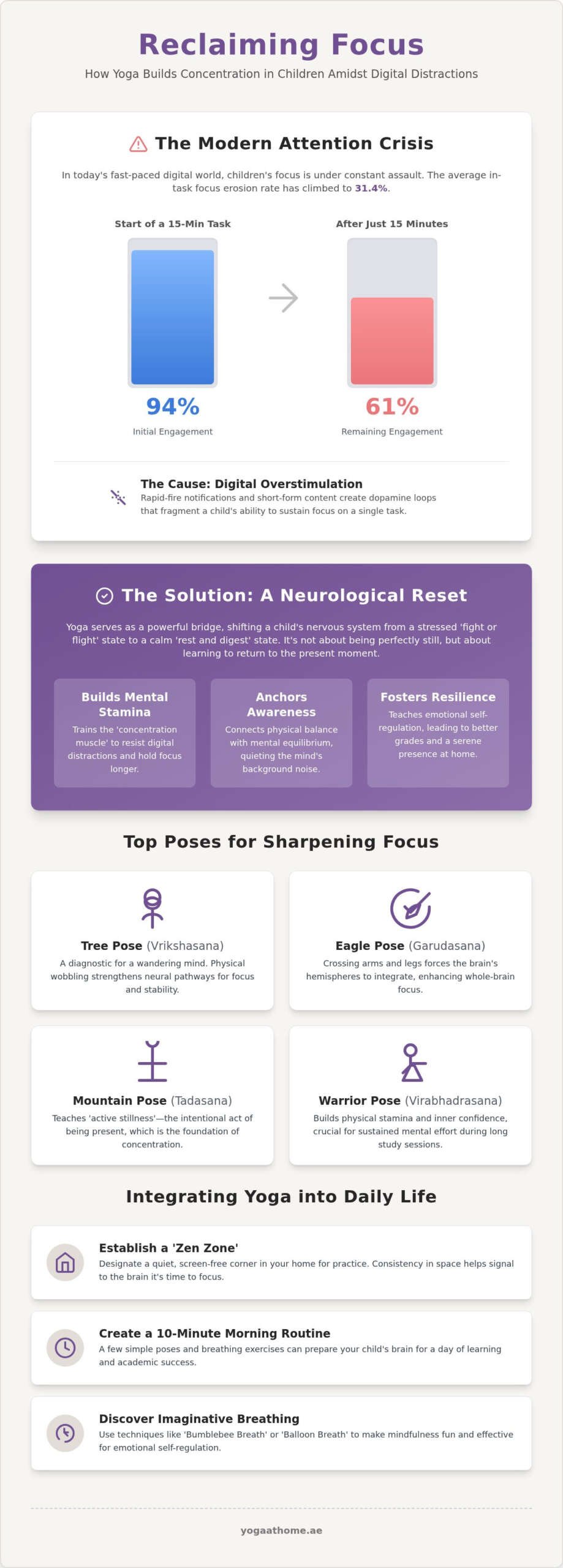
In 2026, the average in-task focus erosion rate in children has climbed to 31.4 percent. For a child aged eight to ten, this means their engagement can drop from 94 percent to just 61 percent within a brief fifteen-minute window. You likely recognize this struggle every time your child drifts toward a screen or feels the heavy weight of academic pressure. It’s a common challenge in our fast-paced world, yet it doesn’t have to be their permanent reality. True wellness is a way of life that begins with internal balance, and we believe that concentration is a muscle rather than a fixed personality trait.
Through the intentional practice of yoga for improving concentration in kids, your child can discover the resistance training they need to sharpen their focus and reduce digital distractions. This guide provides a comprehensive look at how expert-led, specialized techniques build lasting mental clarity and emotional resilience. We’ll explore the specific Hatha movements and breathing exercises that help children regulate their nervous systems, leading to better grades and a serene presence at home.
Key Takeaways
- Understand how to counter the effects of digital distractions on the developing brain through movement-based learning.
- Master specific postures like Tree Pose and Lotus Pose that leverage yoga for improving concentration in kids through physical stillness.
- Discover imaginative breathing techniques designed to balance the brain’s hemispheres and foster emotional self-regulation.
- Learn how to establish a ‘Zen Zone’ at home and a quick ten-minute morning routine to prepare your child for academic success.
- Recognize the value of bespoke, private home sessions that adapt to your child’s specific energy levels and needs.
The Attention Crisis: Why Kids Struggle to Focus in 2026
The pursuit of mental clarity begins with understanding the environment our children inhabit. In 2026, the digital world moves at a pace that often outruns a child’s natural cognitive development. We see concentration not as a fixed character trait; it’s a cognitive muscle that requires consistent, intentional training to remain strong. Training this muscle involves more than just physical effort. It requires a gentle, repetitive return to the breath whenever the mind wanders. In a world that rewards split-second attention, yoga teaches the value of the long, sustained gaze. This isn’t just about fitness; it’s about reclaiming the brain’s natural ability to settle and absorb information without the constant need for new stimulation.
For many kinesthetic learners, the static nature of traditional classrooms creates a disconnect between their need for movement and the requirement to remain focused. This friction often leads to frustration rather than learning. Yoga serves as a bridge, offering a way to shift the nervous system from a state of ‘fight or flight’, often triggered by academic stress, to ‘rest and digest.’ By engaging in mindful movement, children learn to anchor their awareness in the present moment. This fosters a sense of internal peace that translates directly to their schoolwork and home life, helping them feel grounded even when the world feels chaotic.
Digital Overstimulation and the Brain
Short-form content and rapid-fire digital notifications create dopamine loops that fragment a child’s focus before it has a chance to deepen. This constant multitasking during early childhood comes with a significant physiological cost, as the brain’s prefrontal cortex is perpetually overtaxed. When a child’s mind is scattered by these external pulses, their ability to follow complex instructions or complete a single task diminishes. Attention fatigue is a state of mental exhaustion where the brain’s inhibitory control mechanisms fail due to the constant processing of high-velocity digital stimuli, now affecting nearly one-third of modern students.
Yoga as a Neurological Reset
There’s a profound connection between physical balance and mental equilibrium. When a child learns to stand steady on one leg, they’re simultaneously training their brain to find stillness amidst external chaos. This process of yoga for improving concentration in kids helps ‘quiet’ the background noise of the mind, allowing the child to reclaim their focus. It’s about creating a foundation for wellness that begins within the safety of the home. Families looking for a structured approach can find a path through specialized yoga classes in dubai that prioritize this mental reset. By focusing on the breath and the body, we help children transition into a restorative state where genuine learning and emotional self-regulation become possible.
Top Yoga Poses for Sharpening Mental Focus in Children
Physical movement serves as a gentle entry point for mental discipline. When a child engages in specific asanas, they aren’t just stretching their limbs; they’re organizing their thoughts and calibrating their nervous system. The body acts as a mirror for the mind. If the body is restless, the thoughts follow suit. By practicing yoga for improving concentration in kids, we provide them with a physical anchor that makes the abstract concept of ‘focus’ tangible and achievable. These poses act as a form of moving meditation, helping children bridge the gap between high-energy play and the quiet required for academic tasks.
- Garudasana (Eagle Pose): This pose requires crossing the arms and legs, which forces the brain to integrate both hemispheres while maintaining a single point of focus.
- Tadasana (Mountain Pose): It teaches ‘active stillness.’ Children learn that standing still is an intentional act of presence, not just a lack of movement.
- Virabhadrasana (Warrior Pose): This sequence builds the physical stamina and inner confidence necessary for sustained mental effort during long study sessions.
Balancing Poses for Immediate Clarity
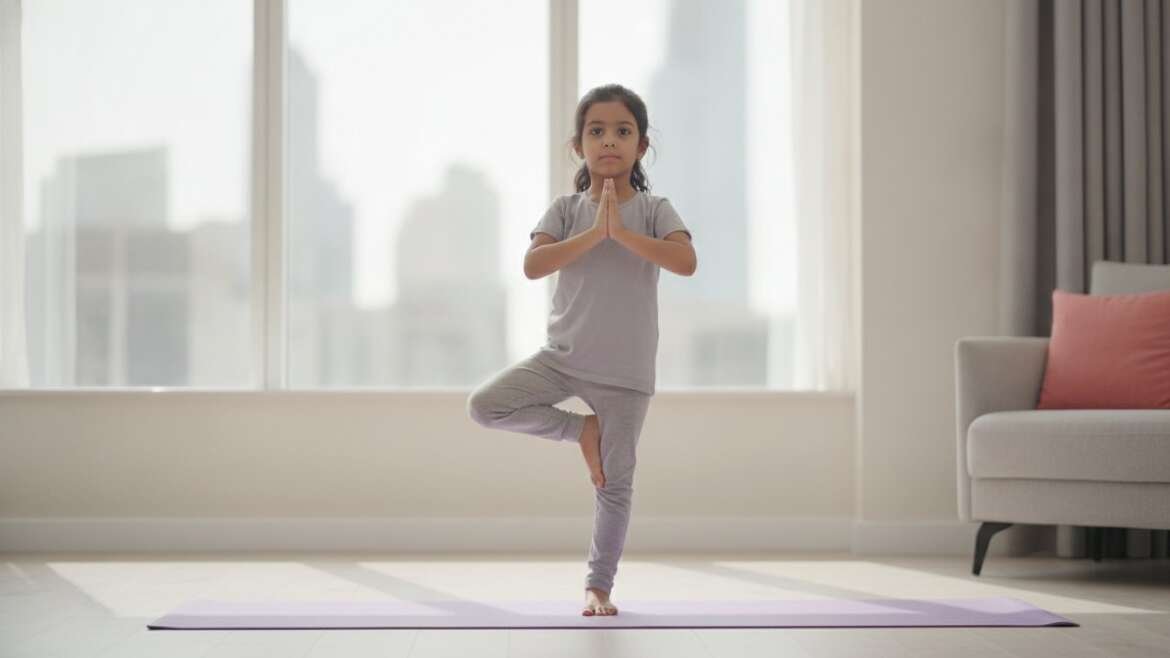
Vrikshasana, or Tree Pose, is the ultimate diagnostic tool for a wandering mind. If a child’s thoughts are drifting toward a digital game or a school worry, they will likely wobble. It is vital to teach them that this wobbling is actually the brain learning to focus; it’s the sound of neural pathways strengthening. For younger practitioners, suggest placing the heel against the opposite ankle like a ‘kickstand.’ Older children can progress to placing the foot on the inner thigh. To anchor their awareness, encourage them to find a ‘Drishti,’ a fixed gazing point on the wall that helps stabilize their internal state.
Grounding Poses for Emotional Stability
While balancing poses sharpen the mind, grounding poses provide the stability needed to stay on task. Padmasana, or Lotus Pose, creates a firm, triangular base that naturally aligns the spine. This posture is essential for maintaining the physical comfort required for deep cognitive work, and it also serves as a foundation for the best yoga poses for back pain as children grow taller and spend more time at desks. Forward folds, such as a seated fold, have a profound cooling effect on an overactive nervous system. These shapes encourage kids to withdraw from external stimuli and find their quiet center, making it easier to transition into homework or reading with a calm demeanor. If you find your child struggling to settle into these shapes, a gentle private yoga session at home can provide the personalized guidance they need to feel comfortable and supported.
The Secret Sauce: Breathing Techniques and Mindfulness
While physical asanas provide the outer framework for discipline, the breath serves as the internal engine for a child’s focus. It is the bridge between the body’s movement and the mind’s stillness. By introducing Pranayama, or controlled breathing, we give children a remote control for their own nervous system. This isn’t just about sitting still; it is about active engagement with their internal state. When we teach yoga for improving concentration in kids, we often use imaginative play to make these ancient techniques accessible. Whether they’re breathing like a slow-moving sea turtle or a powerful dragon, they’re learning to master their own energy levels and mental state.
Nadi Shodhana, or alternate nostril breathing, is a particularly effective tool for balancing the brain’s hemispheres. By gently alternating the flow of air, children help synchronize the logical left side of the brain with the creative right side. This creates a state of ‘whole-brain’ engagement that is perfect for tackling complex school projects. For times when the environment is too loud, the ‘Bee Breath’ (Bhramari) acts as a sensory shield. By making a gentle humming sound during exhalation, children create a vibration that blocks out external noise and redirects their attention inward. These controlled exhalations naturally lower cortisol levels, clearing the mental fog and preparing the mind for deep learning.
Breathwork as a Portable Tool
The beauty of breathwork is that it requires no mat and no special equipment. It’s a portable toolkit children can carry into a stressful exam or a challenging social situation. By tapping into the Vagus nerve, these techniques signal to the brain that it’s safe to move from a reactive state into one of focused observation. Belly Breathing increases oxygen flow to the prefrontal cortex, which is the brain’s headquarters for decision-making and sustained focus. This physiological shift allows a child to pause before reacting, fostering the emotional self-regulation that leads to better grades and a calmer home life.
Mindfulness Beyond the Mat
Mindfulness extends the benefits of a yoga session into every hour of a child’s day. We can use simple visualization techniques, like imagining a clear blue sky where thoughts are just passing clouds, to improve memory retention and clarity. When a child feels hyperactive or overwhelmed, the ‘Five Senses’ exercise provides a quick grounding reset. They simply identify five things they can see, four they can touch, three they can hear, two they can smell, and one they can taste. This process of yoga for improving concentration in kids helps them transition from physical movement to a state of meditative focus, ensuring they remain grounded even in a high-velocity digital world.
Practical Strategies for Parents: Integrating Yoga into Daily Life
Wellness is a way of life, not a scheduled appointment. To effectively utilize yoga for improving concentration in kids, we must weave the practice into the existing fabric of the household. This begins with the environment. Creating a ‘Zen Zone’, a small, dedicated corner with a mat and perhaps a single plant, signals to a child’s nervous system that it’s time to downshift. When the physical space is organized for peace, the mind follows. This sanctuary becomes a bridge, helping children transition from the high-velocity stimulation of screen time to the steady focus required for homework.
It’s vital to avoid framing yoga as another chore on an already crowded to-do list. Instead, present it as a ‘brain break’ or a way to recharge their internal battery. By modeling the behavior yourself, you transform the practice from an instruction into a shared family value. When children see their parents finding stillness, they understand that mental clarity is a prize worth pursuing. This approach lowers resistance and builds a sustainable, life-long relationship with well-being.
The Role of Consistency and Routine
Rhythm creates safety for the developing brain. We’ve found that ten minutes of daily practice is far more effective than a single sixty-minute session once a week. A ’10-Minute Morning Reset’ consisting of simple stretches and grounding breaths can set a serene tone for the entire school day. Rather than focusing on pose perfection, track ‘minutes of stillness.’ Celebrate the moments where your child remains present and calm, as these are the true indicators of progress in yoga for improving concentration in kids.
- Morning: Use Sun Salutations to wake up the body and mind.
- Afternoon: Practice the ‘Bee Breath’ to transition away from digital devices.
- Evening: Focus on grounding forward folds to prepare for restful sleep.
Overcoming Common Obstacles
If your child finds sitting still nearly impossible, don’t force it. Instead, gamify the experience through ‘Focus Challenges.’ Can they balance like a statue for thirty seconds? Can they move in slow motion like a deep-sea diver? These playful prompts build the same cognitive muscles as traditional asanas without the pressure of performance. For households with complex focus challenges or busy schedules, the convenience of a mentor can make all the difference. You can schedule private home-based yoga for kids to receive a bespoke program that adapts to your child’s specific energy levels and needs in real-time.
The Power of Personalized Private Instruction for Kids
Every child carries a unique internal rhythm that dictates how they interact with the world. While group settings offer social interaction, they often fail to address the specific needs of a child struggling with focus or hyperactivity. Private home sessions represent the gold standard for yoga for improving concentration in kids because they allow for total customization. At Yogaathome, we believe that wellness should be a restorative process delivered directly to your doorstep, ensuring your child feels safe and supported in their most familiar environment.
Our REPS UAE and Yoga Alliance certified mentors don’t just teach poses; they adapt the entire flow in real-time. If a child arrives with high, frantic energy, the session begins with dynamic movement to channel that power. Conversely, if they are mentally exhausted from a long school day, the focus shifts toward grounding and restorative breathwork. This personalized pacing ensures that the practice remains effective and engaging, rather than becoming a source of frustration or another academic-style pressure.
Mentorship vs. Instruction
The relationship between a student and their mentor is the foundation of growth. For many families in the UAE, the presence of a dedicated female trainer provides a high degree of comfort and trust, especially in ladies-only households. This mentorship creates a safe space where a child feels comfortable making mistakes or expressing their feelings without judgment. By building this bond, we can customize sequences to target specific academic or behavioral goals, such as increasing the duration of ‘on-task’ engagement for homework or reducing anxiety before exams.
Convenience for the Modern UAE Family
The demanding UAE school calendar often leaves little room for extracurricular travel. By eliminating travel stress and practicing in the home environment, we improve a child’s retention of the techniques they learn. They begin to associate their own living space with a state of calm and focus, which is essential for yoga for improving concentration in kids to have a lasting impact. This scheduling flexibility allows the practice to fit seamlessly into your life, rather than becoming another logistical hurdle. You can Book a personalized private session for your child today to begin this journey toward lasting mental clarity and internal balance.
Cultivating a Future of Focused Presence
True health is a holistic transformation that begins with internal balance. By moving beyond simple physical exercise, your child can develop the cognitive resilience needed to thrive in a digital world. We’ve explored how specific postures and mindful breathing act as a neurological reset, shifting the nervous system toward a state of calm. This journey of yoga for improving concentration in kids is most effective when it’s tailored to their unique energy and practiced in the safety of their own home environment.
Our professional mentors are REPS UAE and Yoga Alliance certified, providing the expertise and trust your family deserves. We deliver bespoke wellness programs directly to your doorstep across the UAE, ensuring that restorative practice fits seamlessly into your busy schedule. This personalized approach allows every child to progress at their own pace while building a foundation of mental clarity that lasts. Empower your child with focus—book a private home yoga session today. We’re here to support your child as they discover their own quiet center and a sustainable path to well-being.
Frequently Asked Questions
At what age can my child start yoga for concentration?
Children can begin their journey as early as age three or four. At this stage, the practice focuses on playful, imaginative movements that introduce the concept of mind-body awareness. As they reach school age, we transition into more structured balancing poses and breathing techniques that are specifically designed to lengthen their natural attention span.
How many times a week should a child practice yoga to see results in focus?
Consistency is the foundational pillar of any restorative practice. We typically recommend two to three sessions per week to build a steady rhythm of mental clarity. When combined with a brief ten-minute daily reset at home, this frequency allows the brain to solidify new neural pathways associated with sustained focus and emotional regulation.
My child is very hyperactive; will they be able to do yoga?
Yes, yoga is an exceptional tool for children with high energy levels. Rather than forcing immediate stillness, we use dynamic Hatha sequences to channel their energy into intentional, mindful movement. This process helps hyperactive children learn how to downshift their own nervous systems, moving from a restless state to one of grounded presence.
Is private home yoga better than a group class for improving focus?
Private instruction is often the gold standard for children who are easily distracted by external stimuli. In a group setting, a child might feel pressured or overstimulated by their peers. Home-based sessions allow a mentor to customize the pace and techniques of yoga for improving concentration in kids, ensuring the practice meets their specific needs.
Can yoga help children with ADHD or learning difficulties?
Yoga serves as a supportive partner in managing ADHD and learning challenges by strengthening the “cognitive muscle” of attention. By focusing on the breath and physical alignment, children learn to quiet the background noise of the mind. This somatic approach to yoga for improving concentration in kids provides them with practical tools to manage frustration and improve academic engagement.
What should my child wear and what equipment do we need for home yoga?
Your child should wear comfortable, breathable clothing that allows them to move freely without restriction. A standard non-slip yoga mat is the only essential piece of equipment needed for a successful session. We encourage parents to set up a dedicated “Zen Zone” in a quiet corner of the home to help the child mentally prepare for their practice.
How long does it take to see an improvement in a child’s concentration through yoga?
Every child follows a unique path, but many families notice a shift in emotional self-regulation within four to six weeks of consistent practice. Improvements in academic focus and the ability to follow complex instructions typically emerge as the child becomes more comfortable with the breathing techniques and balancing poses that anchor their wandering mind.
Are the instructors at Yogaathome certified to work with children?
Every mentor on our team is a REPS UAE and Yoga Alliance certified professional with specialized training in children’s yoga. We prioritize reliable professionalism and deep expertise to ensure your child’s safety and growth. This high standard of certification ensures that our bespoke programs are both effective and grounded in modern physiological understanding.