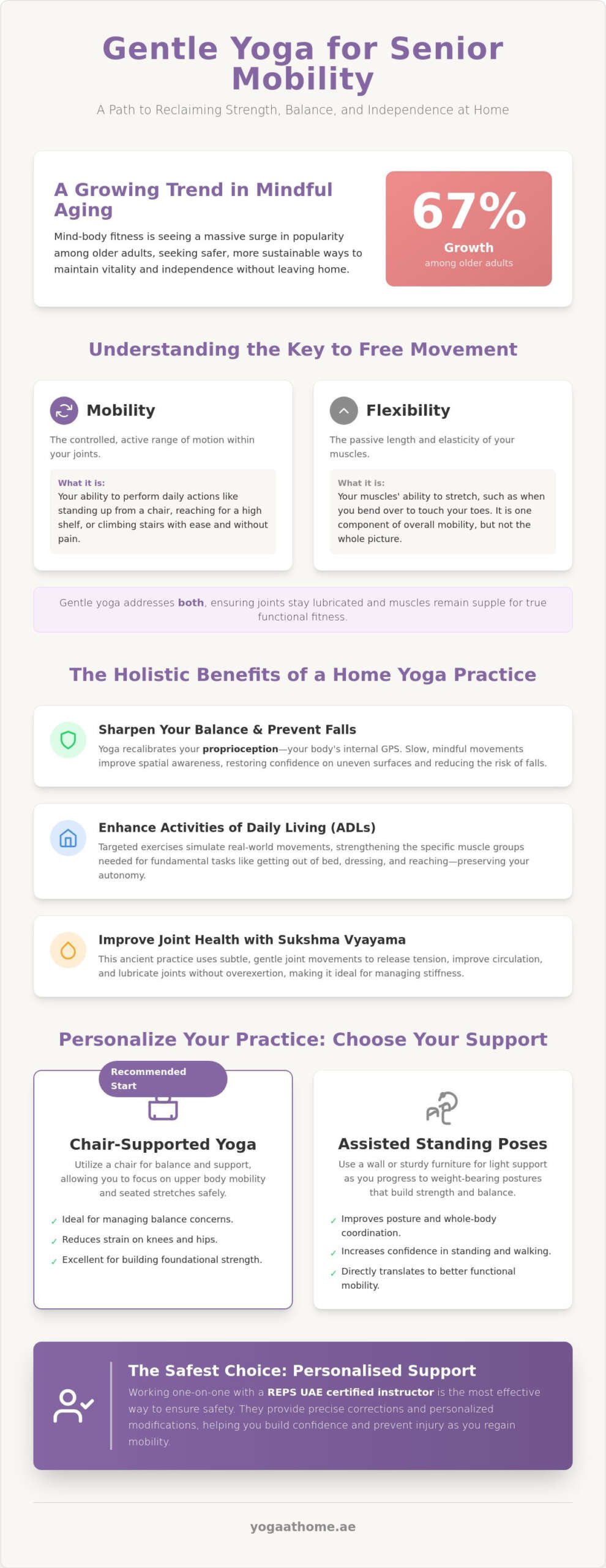
What if the secret to maintaining your independence in your golden years wasn’t found in a crowded gym, but in the quiet sanctuary of your own living room? With mind-body fitness seeing a 67% growth in popularity among older adults according to 2026 industry data, it’s clear that many are seeking a more mindful way to age. For many residents across the UAE, the fear of a sudden fall or the nagging ache of stiff joints can make the world feel smaller every day. You might feel that your body’s best days are behind you, or perhaps the thought of navigating a public fitness center feels more draining than the exercise itself. Practicing gentle yoga for seniors at home offers a restorative path to reclaiming your strength and confidence without leaving your doorstep.
In this guide, you’ll discover how specialized mobility exercises can help you regain your autonomy and reduce the risk of injury through mindful, personalized movement. We’ll explore the science of balance, the relief of joint-focused stretching, and how a bespoke home practice can transform your daily life. Whether you’re looking to climb stairs with ease or simply move through your day with comfort, this holistic approach provides the tools you need for a more vibrant, independent future.
Key Takeaways
- Understand the vital distinction between flexibility and mobility to ensure your exercise routine truly supports your ability to move freely in daily life.
- Discover the ancient practice of Sukshma Vyayama, which uses subtle joint movements to release tension and improve circulation without overexertion.
- Learn how to personalize gentle yoga for seniors at home by choosing between chair-supported poses and assisted standing based on your current comfort level.
- Master five functional mobility exercises that focus on proper alignment to help correct common issues like rounded shoulders and improve your overall balance.
- Explore the safety benefits of working one-on-one with a REPS UAE certified instructor who can provide the precise corrections needed to prevent injury.
Understanding Senior Mobility: Why Movement is the Key to Independence
True health is a state of flowing energy and effortless movement. Mobility is the physical expression of this freedom. It’s the ability to move freely and easily through your daily life without hesitation or restriction. While many people use the terms flexibility and mobility interchangeably, they represent different aspects of your physical wellness. Flexibility refers to the length and elasticity of your muscles, while mobility describes the controlled range of motion within your joints. You can be flexible enough to touch your toes while sitting but lack the mobility to stand up from a low chair without pain. Integrating gentle yoga for seniors at home addresses both needs, ensuring your joints remain lubricated and your muscles stay supple for the long term.
The body follows a profound logic of conservation. If you stop using a certain range of motion, your body eventually restricts it to save energy. This “use it or lose it” principle is particularly relevant as we age. Muscle atrophy and joint stiffness aren’t just inevitable parts of getting older; they’re often the result of sedentary habits that tell the body certain movements are no longer necessary. By engaging in regular, mindful movement, you signal to your system that these physical pathways are still vital. A comprehensive guide to exercise reminds us that physical activity is a pillar of longevity, helping to maintain the structural integrity of the skeletal system while preventing the decline of muscle mass.
Mobility is the currency of autonomy. It’s the difference between walking to the local market for fresh groceries and needing someone to deliver them to you. When you maintain your ability to move, you preserve your connection to your community and your family. Whether it’s playing with grandchildren on the floor or walking through a park with relatives, mobility ensures you’re an active participant in life rather than an observer. It provides the physical foundation for a life lived with dignity and joy.
The Role of Proprioception in Fall Prevention
Proprioception is your body’s silent guardian. It’s an inner sense that tells you where your limbs are in space without you having to look at them. As we age, this spatial awareness can dim, making the floor feel less certain and significantly increasing the risk of falls. Mindful movement, such as gentle yoga for seniors at home, works like a recalibration for this internal GPS. By focusing on slow, deliberate transitions and grounding through the feet, you sharpen your balance and restore the confidence needed to navigate uneven surfaces or stairs safely.
Activities of Daily Living (ADLs) and Mobility
Our quality of life is often measured by how easily we perform Activities of Daily Living (ADLs). These include fundamental tasks such as getting out of bed, dressing ourselves, or reaching for an item on a high shelf. When mobility declines, these simple actions can become daunting obstacles that erode your sense of self-reliance. Targeted mobility exercises simulate these real-world movements, strengthening the specific muscle groups and joint functions required for daily life. Activities of Daily Living (ADLs) serve as the functional benchmark for senior health in 2026.
The Holistic Yoga Approach to Senior Mobility Exercises
Wellness is not a destination but a rhythmic journey of self-care. While many fitness programs focus solely on muscle mass, gentle yoga for seniors at home offers a more sustainable, low-impact method for maintaining vitality. It’s a practice that honors the body’s current state while gently inviting it to expand. By integrating movement with mindfulness, yoga reduces the cortisol-driven anxiety that often accompanies a fear of falling. This shift from exercise to restoration allows you to build confidence in your body’s ability to support you.
Aligning your routine with CDC guidelines for senior physical activity helps ensure you’re meeting essential benchmarks for balance and muscle strengthening. Yoga facilitates these goals through a unique lens. It isn’t just about the poses; it’s about the connection between your intention and your action. This intentionality is what makes yoga particularly effective for those managing chronic conditions or recovering from surgery. If you’re feeling uncertain about where to start, our team can help you design a private yoga practice tailored to your needs.
Sukshma Vyayama: Gentle Joint Articulation
Before attempting complex postures, we must attend to the subtle body. Sukshma Vyayama is an ancient yogic practice focused on small, rhythmic joint movements. These exercises are designed to stimulate the flow of synovial fluid, which is the natural lubricant that keeps joints moving smoothly. For seniors living with arthritis, starting with the smaller joints like the neck, wrists, and ankles is a safer entry point than jumping into weight-bearing poses. Practicing these elements of gentle yoga for seniors at home ensures that the body is warmed up from the inside out.
- Sit comfortably in a chair with your spine tall and shoulders relaxed.
- Slowly rotate your wrists in small circles, performing five rotations in each direction.
- Gently flex and extend your ankles as if pressing a car pedal to improve circulation.
- Finish with slow neck semi-circles, moving ear-to-shoulder with deep awareness.
Pranayama (Breathing) for Physical Stability
Stability begins with the breath. Deep diaphragmatic breathing, or Pranayama, does more than just oxygenate the blood; it creates an internal pressure that stabilizes the core. As we age, lung capacity naturally decreases, which can lead to fatigue during simple tasks. By practicing conscious breathing, you improve your physical endurance and create a calm nervous system. This foundational support is especially helpful when exploring the best yoga poses for back pain, as a stable core protects the spine during every movement.
Comparing Mobility Modalities: Chair Yoga vs. Assisted Standing
Every body is a unique landscape with its own peaks and valleys. Mobility exists on a spectrum, and honoring where you stand today is the first step toward a more vibrant tomorrow. For many, the journey into gentle yoga for seniors at home begins with a simple question: should I sit or stand? There’s no single answer that fits everyone. The choice depends on your current balance, joint comfort, and energy levels. By adapting the practice to your specific needs, you ensure that movement remains a source of healing rather than a cause of strain.
Choosing the right modality is about respecting your boundaries while gently pushing their edges. If you’re following a structured senior workout plan, you’ll notice that the most effective routines offer modifications for every stage of life. The transition from a seated practice to standing work is a significant milestone, but it’s one that should never be rushed. We move from the stability of the chair to the support of the wall, eventually finding the strength to stand unassisted in the center of the room. You’ll know you’re ready for unassisted work when your breath remains steady and your feet feel firmly rooted during assisted poses.
When to Choose Chair-Based Exercises
A chair is not a sign of limitation; it’s a tool for precision. You should consider a seated practice if you experience frequent dizziness, severe knee pain, or if your balance feels unreliable on certain days. Seated twists are exceptionally effective for maintaining spinal rotation without the risk of a fall, while seated leg lifts build the hip strength required for steady walking. It’s vital to remember that chair yoga is real yoga. It provides the same nervous system regulation and joint articulation as any other form of the practice, making it a cornerstone of gentle yoga for seniors at home for those prioritizing safety and comfort.
The Progression to Assisted Standing
Once you feel a sense of groundedness in your seated practice, you might feel ready to explore assisted standing. This phase uses a sturdy chair or a wall as a silent partner to provide stability. It’s a beautiful middle ground that builds bone density and functional strength. One of the best transitional exercises is the Heel-to-Toe walk, often called the “tightrope walk.” By keeping one hand on a wall, you can safely challenge your gait stability and proprioception. Using these props isn’t a crutch. It’s a strategic way to build the confidence needed to eventually move away from support and reclaim your full range of motion.
5 Essential Senior Mobility Exercises for Daily Vitality
Movement is the language of life. To move with grace is to honor the vessel that carries us through the world. When practicing gentle yoga for seniors at home, the focus is never on the speed of the repetition or the intensity of the effort. Instead, we prioritize the integrity of the alignment and the depth of the breath. Slow, controlled movements allow the nervous system to feel safe, preventing the protective tightening of muscles that often leads to injury. Before embarking on these movements, please consult with your healthcare provider to ensure they align with your specific medical history and physical needs.
The Sit-to-Stand (Modified Chair Pose)
To maintain the independence of rising from a sofa, bed, or car seat, we must nurture the strength of the lower body. This exercise is a functional variation of Utkatasana, or Chair Pose. Begin by sitting near the edge of a sturdy chair with your feet hip-width apart. Root down through the soles of your feet, ensuring your weight is distributed toward your heels. As you exhale, lean slightly forward from the hips, keeping your spine long and your chest open to avoid rounded shoulders. Press firmly through your feet to rise slowly to a standing position. This controlled ascent mimics the techniques used in professional yoga classes in dubai, where instructors emphasize the connection between the core and the quadriceps. Lower yourself back down with the same intentionality to build lasting stability.
Tadasana (Mountain Pose) for Postural Alignment
Standing tall is a physical act that yields profound mental clarity. Tadasana is more than just standing; it’s an active engagement of the entire body that counters the tendency to slouch. By aligning the ears over the shoulders and the shoulders over the hips, you expand the space for your lungs to breathe fully. This increased oxygenation supports both physical endurance and cognitive function. Ground yourself by feeling the connection between your feet and the floor, lifting the arches slightly to engage the legs. Tadasana is the foundational pose for all senior standing mobility.
Seated Spinal Twists for Digestive and Back Health
A healthy spine is a supple spine. Seated twists provide a gentle way to maintain the rotation of the vertebrae, which often becomes restricted with age. Sit tall in your chair, imagining a thread pulling the crown of your head toward the sky. As you exhale, gently turn your torso to one side, using the chair’s back or armrest for light support. Avoid the temptation to over-twist or use your arms to force the movement; let the rotation come from your mid-back. This movement provides a subtle massage for the internal organs, which aids digestion and releases lower back stiffness. Always prioritize length in the spine before initiating the turn to ensure the discs are protected.
If you’re ready to experience these benefits with expert, one-on-one guidance in your own living room, schedule a private session with one of our certified instructors to begin your journey toward restorative health.
Personalised Support: Why Private Home Yoga is the Safest Choice
Wellness is an intimate journey that deserves a quiet, focused space. While group classes offer community, they often fail the individual by prioritizing a collective pace that can be overwhelming for those with specific physical needs. In a public setting, the instructor’s attention is divided, and subtle misalignments in your posture might go unnoticed. For those practicing gentle yoga for seniors at home, private instruction ensures that every movement is monitored with absolute precision. Our REPS UAE certified instructors provide a level of safety and professional reliability that generic online videos or crowded studios simply can’t match. They act as vigilant partners, adjusting each pose to fit your unique anatomy and energy levels on any given day.
This bespoke approach is particularly valuable for residents across the UAE who may face transport limitations or find public fitness centers intimidating. Instead of navigating traffic or coordinating a ride to a gym, the sanctuary of your living room becomes the studio. We bring the expertise directly to your door, respecting your schedule as much as your personal growth. By removing the logistical hurdles of travel, you can dedicate your full energy to the restorative process. It’s a sustainable way to make health a permanent part of your lifestyle without the stress of a public environment.
Tailored Sessions for Specific Health Needs
Every body carries a different story, and our instructors are trained to listen. Whether you’re managing the daily discomfort of arthritis, the structural concerns of osteoporosis, or recovering from a heart condition, we adapt the practice to support your recovery. We don’t believe in a one-size-fits-all approach. During your first session, we conduct a personalized assessment to understand your current range of motion and health goals. For our female clients, we offer ladies-only private sessions with experienced female trainers to ensure complete comfort and cultural privacy. This level of customization transforms gentle yoga for seniors at home from a simple exercise routine into a powerful, targeted tool for holistic vitality.
Creating a Restorative Environment at Home
Healing happens most effectively in a place where you feel secure. Your home is a familiar sanctuary that naturally lowers cortisol levels, allowing your nervous system to fully relax and receive the benefits of the practice. This comfort reduces the performance anxiety often felt in traditional athletic settings, where you might feel pressured to keep up with others. We integrate meditation and diaphragmatic breathing into every session, creating a holistic experience that nurtures both the mind and the body. By removing the external noise of a public class, you can focus entirely on your internal balance and the steady, calming rhythm of your breath.
Experience the benefits of private senior yoga at home with Yogaathome and rediscover the joy of moving with confidence.
Embrace a Future of Fluid Movement and Independence
Health is a rhythmic journey of restoration. We’ve explored how the distinction between flexibility and joint mobility is essential for maintaining your autonomy in 2026. By integrating ancient practices with modern functional exercises, you can transform your daily life and reclaim the activities you love. Whether you begin with the stability of a chair or progress toward assisted standing, the goal remains the same: moving through your world with quiet confidence and ease.
Choosing gentle yoga for seniors at home provides a safe, private environment where your specific needs are the primary focus. You don’t have to settle for generic fitness routines that don’t respect your body’s unique story. Our REPS UAE and Yoga Alliance certified instructors specialize in bespoke programmes for arthritis and back pain, providing expert guidance right at your doorstep. For our female clients, we also offer specialized ladies-only private trainers to ensure a comfortable and serene experience.
Book Your Personalised Senior Yoga Session Today and start your journey toward holistic vitality and lasting independence.
Your body has an incredible capacity for renewal. It’s never too late to listen to its wisdom and move toward a life of greater freedom and joy.
Frequently Asked Questions
Is yoga safe for seniors with limited mobility or arthritis?
Yes, yoga is exceptionally safe and beneficial for those with arthritis because it focuses on gentle joint articulation. By practicing gentle yoga for seniors at home, you can stimulate synovial fluid flow without putting undue stress on the joints. Our instructors specialize in modifying poses to accommodate limited ranges of motion, ensuring that the practice remains restorative and pain-free for every participant.
How often should a senior perform mobility exercises for best results?
Consistency is the foundation of progress, so performing mobility exercises daily or at least three to five times per week is ideal. Following the CDC guidelines for older adults, you should aim for approximately 150 minutes of moderate activity weekly. Even ten minutes of focused stretching each morning can significantly reduce stiffness and improve your overall coordination throughout the day.
Do I need special equipment to start senior mobility exercises at home?
You don’t need a professional gym setup to begin your journey toward better health. A sturdy, armless chair and a non-slip yoga mat are usually sufficient for most gentle yoga for seniors at home sessions. We often use household items like walls for balance support or cushions for extra comfort, making the practice accessible and easy to maintain in your own living space.
Can mobility exercises help prevent falls in the elderly?
Mobility exercises are a powerful tool for fall prevention because they sharpen your proprioception and strengthen your core. By training your body to sense its position in space, you become more adept at recovering your balance if you trip. Regular practice builds the functional lower body strength required to navigate stairs and uneven surfaces with much greater confidence.
What is the difference between senior yoga and a regular yoga class?
Senior yoga prioritizes functional movement and safety over athletic intensity or complex inversions. Unlike a standard group class, these sessions move at a slower pace and use props like chairs to make every pose accessible. The focus is on improving your ability to perform daily tasks comfortably rather than achieving a specific aesthetic shape or advanced posture.
Can I do these exercises if I have had a hip or knee replacement?
Yes, you can practice yoga after a joint replacement once your doctor has provided clearance for physical activity. Our instructors are trained to avoid movements that might compromise the prosthetic, focusing instead on gently strengthening the surrounding muscles. Professional guidance is essential here to ensure you aren’t overextending the joint or moving in a way that hinders your recovery.
Is it better to do mobility exercises in the morning or evening?
The best time for mobility work depends on your body’s unique needs and daily rhythms. Many find that a morning practice helps clear the stiffness accumulated during sleep, while others prefer an evening session to release the day’s tension. What matters most is choosing a time when you can focus fully on your breath and movement without feeling rushed or distracted.
Why should I choose a REPS UAE certified instructor for senior yoga?
Choosing a REPS UAE certified instructor ensures that your trainer has met the highest professional standards for health and safety in the Emirates. This certification guarantees that the instructor understands the physiological needs of older adults and can provide a safe, effective practice. It offers peace of mind that you’re working with a mentor who respects your physical boundaries and local regulations.